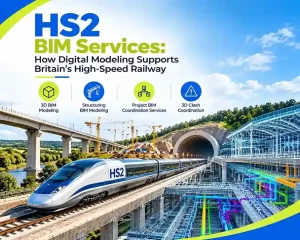
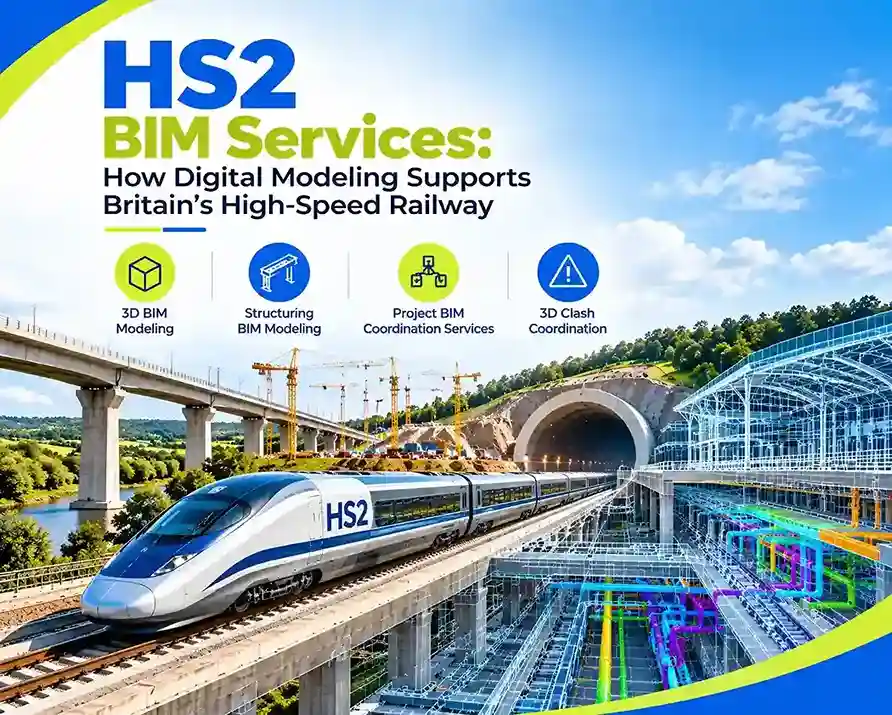
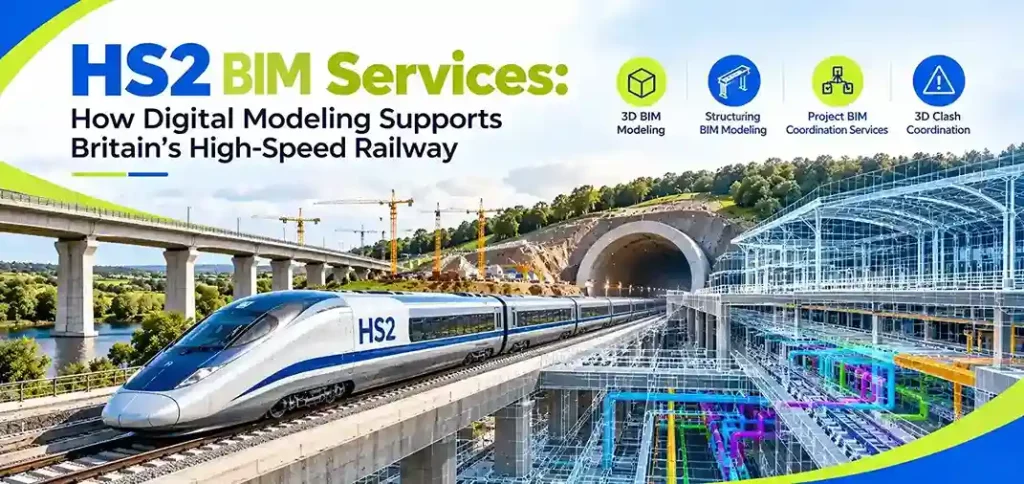
HS2 BIM Services are a useful way to understand how digital tools can support one of the UK’s largest infrastructure projects. HS2 is the new high-speed line linking London with the West Midlands, and it involves tunnels, viaducts, stations. Building Information Modeling (BIM) is more than a 3D drawing. It is a shared digital model that carries information from design through construction and operation. Good 3D BIM Modeling gives every team the same clear picture to work from.
HS2 BIM Services and the Scale of the Railway
Project BIM Coordination Services matter most on schemes spread across many sites and contractors, and HS2 fits that description. Phase 1 covers roughly 140 miles of route with four stations. After the 2026 reset, current estimates put the cost at £87.7 billion to £102.7 billion in 2025 prices. The current programme expects first services between Old Oak Common and Birmingham Curzon Street from May 2036 to October 2039. That is why discussions about HS2 BIM Services focus so heavily on coordination.
Why HS2 Is So Technically Complex
The route crosses hills, rivers, roads and existing lines, so it needs very different structures. The Chiltern Tunnel runs for about 16 km beneath the Chiltern Hills, and the 3.4 km Colne Valley Viaduct is the longest railway bridge in the UK. Stations such as Old Oak Common add deep concrete boxes and building services. Track, power and signalling must fit into the same corridors, with a maximum operating speed of 320 km/h (200 mph). Different teams design each of these elements, and 3D Clash Coordination gives them a way to spot conflicts before they reach site.
Also Read: BIM for Infrastructure: Bridges, Roads & Tunnels
HS2 at a glance: key elements and where BIM fits
| HS2 Project Element | Important Information | How BIM Can Help |
| Overall project | About 140 miles of route; current estimates of £87.7bn–£102.7bn (2025 prices) | Shared 3D models and common project data |
| Colne Valley Viaduct | 3.4 km; the UK’s longest railway bridge | Structural modeling, coordination, clash detection |
| Chiltern Tunnel | Approximately 16 km twin-bore tunnel | Tunnel modeling, coordination, construction planning |
| Old Oak Common | Major west London interchange with 14 platforms | Architectural, structural and MEP coordination |
| Birmingham Curzon Street | Phase 1 terminus station in central Birmingham | 3D modeling, coordination and documentation |
| Construction complexity | Multiple disciplines and contractors | Project BIM coordination |
| Cost and quantity management | Large-scale infrastructure with a reset cost range | 5D BIM and quantity information |
How HS2 BIM Services Support Design and Structures
HS2 BIM Services can start at the design stage, where a 3D model shows how alignments, structures and stations fit together. Designers can check clearances and share one version of the design with contractors. Civil and structural teams can attach materials and element types to each object. That helps engineers review viaduct piers, station boxes and tunnel linings more quickly. For structures this complex, Structuring BIM Modeling keeps every element organised, named and ready for design checks.
Coordination and Clash Detection Before Construction
Project BIM Coordination Services bring the models from each discipline into one federated model that the whole team reviews regularly. On a railway, that can include structures, drainage, utilities, tunnel systems and station services. Coordinators log each issue, assign it to the responsible team and track it until it is closed. The result is a clearer set of decisions made at the desk, not in the field.
3D Clash Coordination looks for physical conflicts, such as a duct running through a beam or a cable route blocked by a pier. For a project of this size, HS2 BIM Services should include clear clash rules, agreed tolerances and named owners, so reports lead to real fixes. Correcting a conflict in the model costs far less than correcting it after the concrete is poured.
HS2 BIM Services Beyond Design: Sequencing, Quantities and Handover
Once the design is coordinated, the model can be linked to the construction programme. This is 4D BIM. Teams can see when a tunnel portal, viaduct span or platform is due to be built, and how work areas and access routes will interact. Construction sequencing becomes easier to discuss and challenge before crews mobilise.
5D BIM adds cost information. Quantities of concrete, steel or reinforcement can be taken from model objects, which supports cost planning and reduces manual take-offs. It gives estimators a more reliable starting point when designs change.
The model does not have to end at handover. As-built BIM records what was actually built, and that information can support maintenance, inspections and asset management. In some cases it can feed a digital twin that links the physical railway to regularly updated data.
Taken together, BIM can bring:
- Better coordination between disciplines
- Earlier identification of design conflicts
- Improved construction planning
- More reliable quantity information
- Better communication between project teams
- More useful as-built information
This matters most when many disciplines and contractors are involved. Each party may use different software and timelines. A shared model, agreed standards and clear responsibilities keep everyone working from the same information.
Disclaimer: BIMServices.net is sharing the information in this article for educational and informational purposes only. BIMServices.net does not claim that the HS2 project has used BIM services from BIMServices.net, nor does this article confirm which specific BIM service providers or BIM workflows have been used on the HS2 project. The BIM applications discussed are presented as examples of how BIM can support large and complex infrastructure projects.
Conclusion
HS2 is a highly complex infrastructure project, with long tunnels, major viaducts, large stations and many contractors working in parallel. On a railway of this scale, BIM helps teams share information, model structures accurately and find conflicts before construction begins. Understanding HS2 BIM Services shows how coordination, modeling and clash detection work together from design through to asset information. The same principles apply to any large railway, road or tunnel scheme, whatever its size. Teams planning similar work can look at Project BIM Coordination Services to see how these processes are managed in practice, from early models to final handover.