

MEP projects don’t go wrong because teams don’t know electrical design. They go wrong because coordination breaks down—ceilings get congested, routes change late, openings get missed, and site teams start “adjusting” work in the field. Electrical BIM reduces that chaos by making electrical intent visible in 3D and tying it to usable project data.
If you’re an MEP consultant, electrical engineer, or contractor, you care about three things: fewer clashes, faster installation, and fewer surprises on site. That’s what this is about.
What Electrical BIM means in MEP coordination
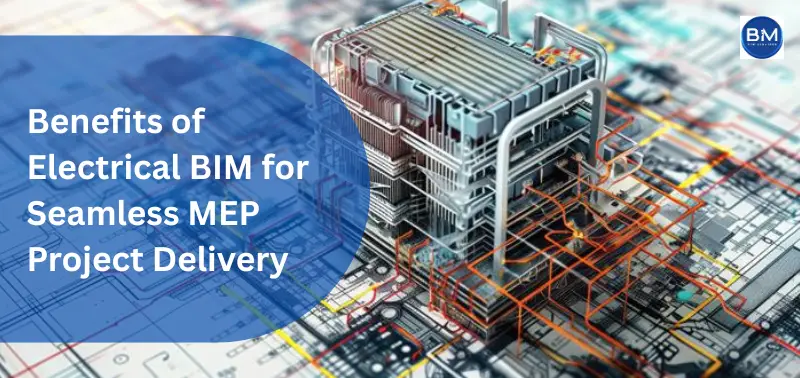
Electrical BIM is not just a 3D electrical drawing. It’s an information-rich electrical model that includes containment (cable trays/conduits where needed), equipment, devices, clearances, elevations, and—when the workflow is mature—data like panel IDs, circuiting, and loads. In an MEP environment, Electrical BIM becomes the coordination “truth” that helps every trade share the same ceiling space without fighting for it.
Key benefits of Electrical BIM in MEP projects
- Clash reduction across trades (HVAC, plumbing, fire, structural) before work reaches site
- Better constructability through realistic routes, elevations, access, and clearance checks
- Faster coordinated drawings (plans, RCPs, risers, electrical room layouts) with fewer revisions
- More reliable quantities for procurement and cost control
- Cleaner handover when the model is maintained for as-built and asset data
That’s the shortlist. Now here’s what those benefits look like in real project terms.
1) Electrical BIM cuts clashes before they become site rework
Most electrical “issues” are actually coordination issues: cable trays conflict with ducts, conduit routes hit beams, lights shift after ceiling coordination, or panels get placed without proper access clearance. Electrical BIM allows you to solve these conflicts early in a coordinated model environment instead of discovering them in the field. In practice, Electrical BIM helps teams lock down corridor zones, riser paths, and ceiling priorities. When containment and major equipment routes are resolved early, you stop wasting time on repeated redraw cycles and emergency reroutes during installation.
2) Electrical BIM improves constructability, not just coordination screenshots
A model is only useful if it supports installation reality. Electrical BIM becomes valuable when it considers how electricians actually build: bend limitations, workable routing, access space around panels and switchgear, and clear paths through shafts and service zones. This is where contractors feel the biggest impact. When the model is constructible, the job becomes predictable: fewer last-minute changes, fewer “make it fit” decisions, and fewer delays caused by other trades blocking electrical routes.
3) Electrical BIM speeds up coordinated drawings and reduces revision pain
Electrical BIM makes updates easier to manage because a coordinated model reduces drawing contradictions. When elevations, routes, and equipment placements are controlled inside the model, you spend less time fixing mismatched plans and more time moving the project forward. It also helps when projects repeat typical floors or zones (hotels, residential towers, hospitals). Once your standards and families are clean, Electrical BIM supports consistent documentation across levels, which reduces coordination drift from floor to floor.
4) Electrical BIM strengthens quantities, procurement, and cost decisions
Electrical quantities are hard to estimate accurately when routes keep changing. Electrical BIM supports better takeoffs—especially for containment—because it reflects the coordinated routing instead of an assumed routing based on 2D plans. That means fewer procurement errors like ordering short, buying the wrong fittings, or holding excess material. It also helps project teams track cost impact when coordination changes happen, instead of finding out after installation.
5) Electrical BIM supports system logic: panels, loads, and circuit coordination
In a mature workflow, Electrical BIM carries data that helps engineers and consultants validate design intent during coordination. Panel schedules, circuit assignments, connected loads, and equipment parameters become easier to manage when the model is structured and naming standards are consistent. This matters because MEP coordination is not only about space. It’s also about making sure electrical requirements align with mechanical equipment power needs, equipment locations, and final room layouts.
6) Electrical BIM reduces execution surprises through early openings and sleeve planning
A lot of site delays come from one simple miss: openings weren’t coordinated early enough. Electrical BIM improves collaboration with structural and civil teams by identifying penetrations and sleeves before pours and before major framing closures. Even if you don’t run full 4D planning, Electrical BIM still supports sequencing decisions by showing where the “must-not-miss” items are—risers, main trays, shafts, electrical rooms, and slab penetrations.
7) Electrical BIM improves QA/QC and closeout value
Electrical BIM also supports better QA because issues become visible early: wrong device elevations, clearance violations, naming inconsistencies, and route conflicts show up faster in 3D than in stacked 2D plans. If the model is maintained during construction, it becomes a stronger closeout record for owners—especially for large facilities where future upgrades and maintenance depend on accurate system location data.
Where Electrical BIM gives the highest ROI
Electrical BIM delivers the strongest value in high-density, high-change environments like hospitals, labs, airports, hotels, data centers, and complex commercial buildings. The more congested the ceiling space and the tighter the schedule, the more Electrical BIM saves time and money.
The truth: Electrical BIM only works if the workflow is disciplined
If teams model without standards, skip regular coordination cycles, or treat BIM like “just 3D,” the benefits drop fast. Electrical BIM creates results when it is tied to real deliverables—coordination sign-offs, sleeve packages, shop drawings, and installation-ready routes.