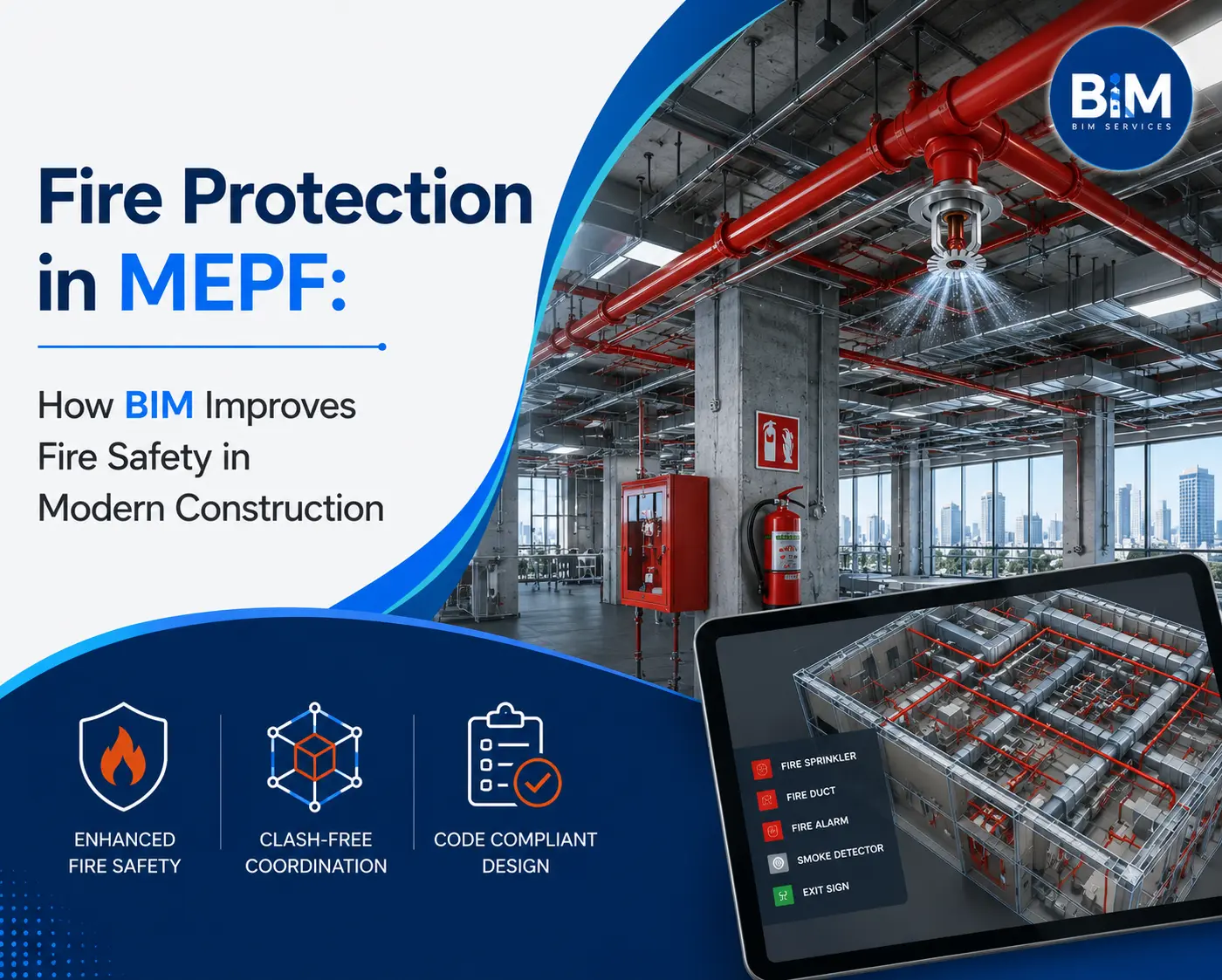
Imagine a bustling office building at 2 AM. A minor electrical failure occurs within a service riser. In less than a minute, the fire alarm detects the heat, the sprinklers activate, and the smoke dampers cut off access to the entire floor – all before the people in the building can smell the smoke. This is fire protection performing its function perfectly. Within the realm of MEPF is the only discipline which allows very little room for mistakes, and BIM is revolutionizing the process.
What is Fire Protection in MEPF?
Fire protection can be defined as the component of MEPF (mechanical, electrical, plumbing, and fire) which involves early detection of a fire and its control in order to give occupants sufficient time to escape from a building. This is not a singular system. This is a combination of several systems, such as sprinklers, alarms, hydrants, pumps, standpipes, and fire suppression equipment, which have to function together whenever an emergency occurs.
The objective is simple enough, despite the complicated engineering involved: people come first; then property and assets; and finally, critical systems like data centers and hospitals should always continue to function if at all possible. When it comes to current buildings, fire protection cannot be left to the last minute, an auxiliary system that gets added on after all the other considerations have been made. It must be considered along with HVAC systems, electrical conduit, and plumbing systems from the start since all are vying for the same space in the ceilings and risers.
Main Components of a Fire Protection System
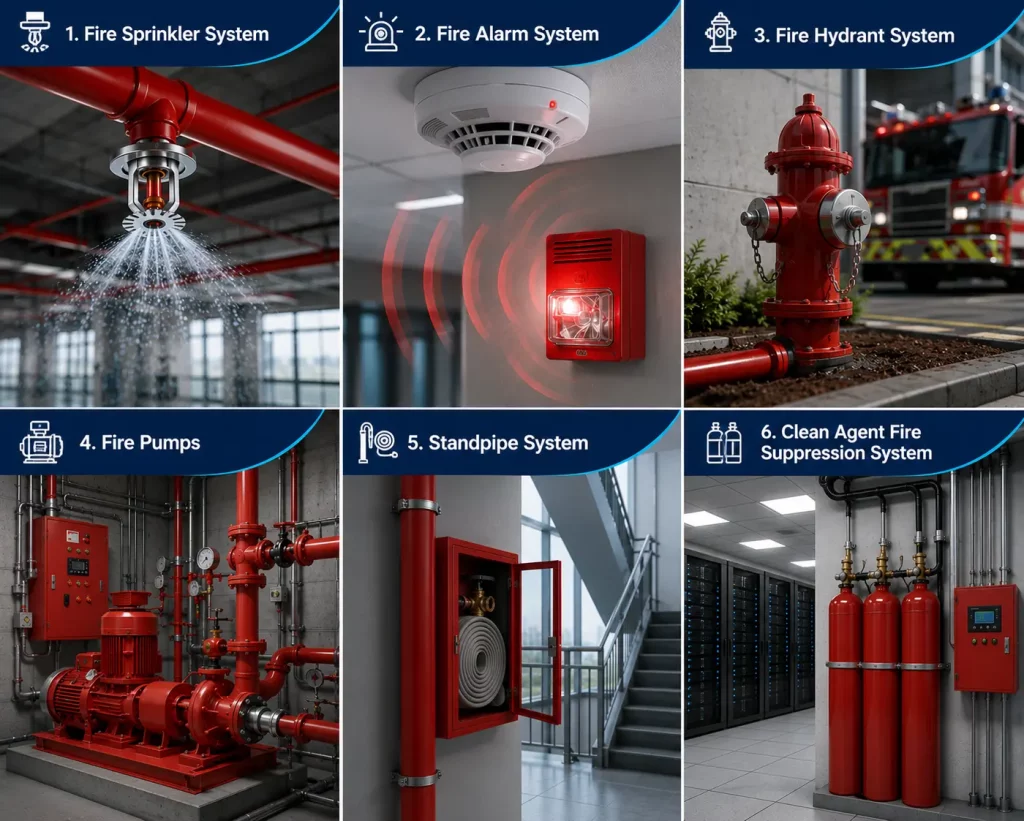
- Fire Sprinkler System: This is the fire protection mainstay. The sprinkler heads start dispensing water as soon as they detect heat. They target the fire before the fire can spread. Sprinklers are installed in almost all types of buildings, including warehouses, hospitals, and high-rise residential buildings, since they are known to reduce fire spreading and minimize losses caused by fires. The reason for their importance lies in a single statement: sprinklers are faster than people.
- Fire Alarm System: Fire alarm systems are the voices that give early warnings of any fire within the building. They work through smoke and heat detection, which is done by alarms that sound and lights that flash when a fire occurs. They are applied anywhere, whether it is in office buildings, schools, or industrial facilities, and their importance is in giving warnings quickly.
- Fire Hydrant System: A fire hydrant provides the firefighters with pressurized water after they arrive at the scene of fire. They are generally installed on the outer periphery of the structure, and are linked to the water mains. In large industrial complexes, this becomes the primary resource for the external firefighting teams without the need for water tanker trucks.
- Fire Pumps: The fire pumps are responsible for increasing the pressure of the water so that it can be supplied through the sprinkler system, hydrants, and hose outlets, even when there is a need to reach high levels within any building or facility distant from the main source of water supply. This is especially important for high-rise buildings.
- Standpipe System: A standpipe is an arrangement of pipes going vertically through a structure and allowing firefighters to hook up their hoses at any level without having to drag the hose lines all the way up the staircase. Standpipes are used in mid- and high-rises and are important because every second counts when responding to a fire.
- Clean Agent Fire Suppression Systems: Fire suppression systems that do not make use of water but rather gases are very useful in cases when a loss due to the fire can be compared to that caused by water leakage. Such fire suppression systems are vital since they help to put out fires and save valuable equipment.
How Building Information Modelling Supports Fire Protection
That is when Building Information Modelling gets its good name. The fire protection system, ventilation ductwork, plumbing pipes, electrical conduits, and structural steel all occupy the same physical space, and their interferences would happen at the construction site, typically at the most inconvenient time. However, with BIM technology, these clashes can be detected early on, even before any of them are installed.
Coordinating also becomes more cooperative. MEPF engineers, the structural team, and the architect all operate in the federated model, so coordination between the sprinkler main and the duct is achieved in one sitting rather than in endless back-and-forth emails and on-site confrontations. The 3D visualization even benefits non-technical people such as the client or building owner who might be unable to comprehend technical drawings.
Since there are no mistakes when the planning of the routing occurs in digital format initially, there are fewer construction errors, and the team installing the equipment has plans that have taken into consideration all constraints existing in reality. Many companies that provide professional BIM Services take such coordination into account right at the stage of fire protection.
Fire Protection Codes and Standards
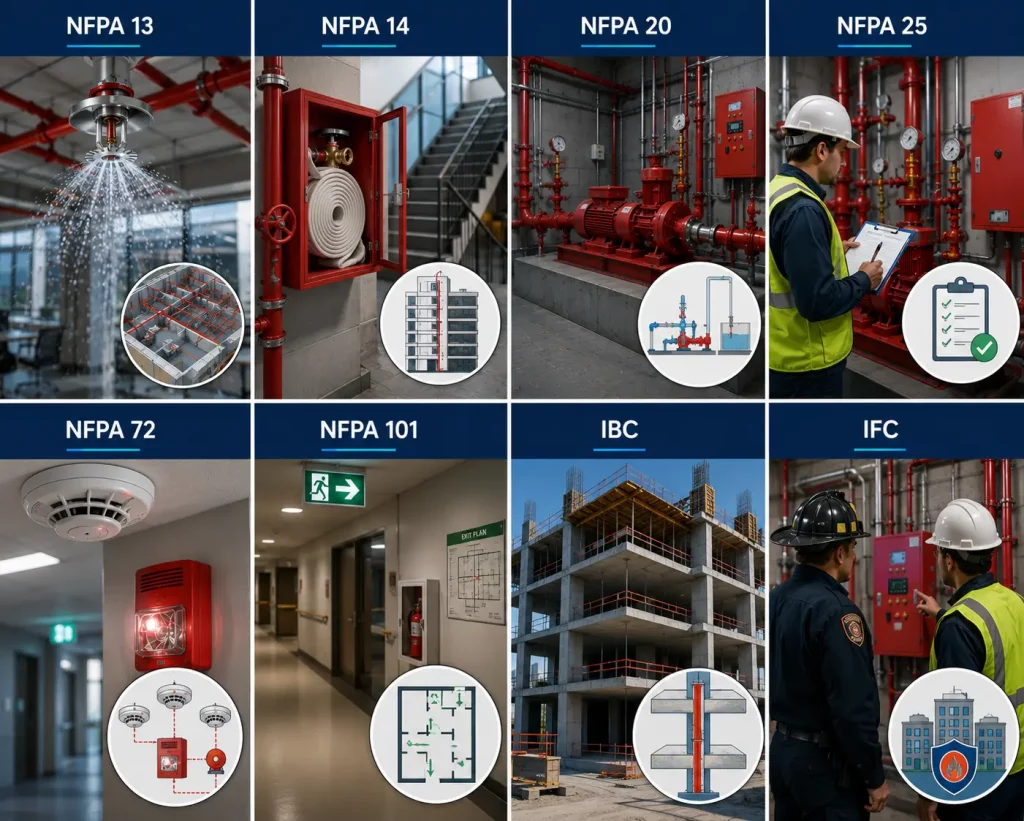
The fire protection design process is not performed in isolation from other factors. There are a number of codes and standards in place which determine everything from spacing between sprinklers to the size of pumps. Some of the most common are the following:
| Standard / Code | Purpose | Where It Applies |
| NFPA 13 | Standard for the design and installation of automatic fire sprinkler systems | Commercial, residential, and industrial sprinkler system design |
| NFPA 14 | Standard for the installation of standpipe and hose systems | Mid-rise and high-rise buildings |
| NFPA 20 | Standard for the installation of stationary fire pumps for fire protection | High-rise buildings and large facilities needing boosted water pressure |
| NFPA 25 | Standard for inspection, testing, and maintenance of water-based fire protection systems | Ongoing facility management and life-safety compliance |
| NFPA 72 | National Fire Alarm and Signaling Code covering detection and notification systems | Fire alarm system design across all occupancy types |
| NFPA 101 | Life Safety Code addressing occupant safety and egress requirements | Building design, means of egress, and occupant protection |
| International Building Code (IBC) | Sets construction, fire-resistance, and life-safety requirements for buildings | General building design and permitting across most jurisdictions |
| International Fire Code (IFC) | Establishes fire prevention and protection requirements for existing and new buildings | Fire safety compliance during construction and building operation |
Common Challenges in Fire Protection Design
Fire protection design is often plagued by certain recurring challenges even when meticulous planning is done. Conflicts between pipes and ducts or cable trays occur frequently due to lack of space under the ceilings. Sprinklers may become too close to the beams or lights and cover less area than designed. Adequate maintenance space near the fire pumps and valves may not be provided until it becomes impossible for a serviceman to reach those items. Design revisions made during the last minute may have a ripple effect on the fire protection plan.
BIM solves almost everything related to this problem even before the first pipe is put in the ground. The clash detection software immediately notifies the team about any clash in the model; therefore, the team can correct the routes without removing already installed pipes. As all trades are modeled at once, any alteration in the electrical system layout will automatically reflect its effect on fire protection clearances and engineers can rectify it on the screen instead of the scaffolding.
Benefits of BIM for Fire Protection Projects
- Better coordination between fire protection and every other MEPF system, since everyone works from one shared, accurate model.
- Increased occupant safety, because clash-free, properly placed systems perform the way they were designed to.
- Faster project delivery, with fewer stoppages caused by field conflicts that should have been caught earlier.
- Reduced rework, which saves both materials and labor hours that would otherwise go into fixing avoidable mistakes.
- Improved code compliance, since the model can be checked against NFPA and building code requirements throughout design.
- Easier facility management, because the as-built model becomes a long-term reference for inspections, maintenance, and future renovations.
- More accurate construction documentation, giving contractors and inspectors drawings that actually match what gets built.
Conclusion
Fire safety will continue to be one of the toughest specialties in MEPF since there can be no tolerance for mistakes where life is involved. With Building Information Modeling supported by smart BIM Services, the design, coordination, installation, and subsequent management of these systems can be achieved with a degree of accuracy never before possible through hand-drawn drawings. As buildings become taller, more densely populated, and more sophisticated, BIM is rapidly shifting from a luxury to a necessity and contributing toward the construction of safer and smarter buildings.