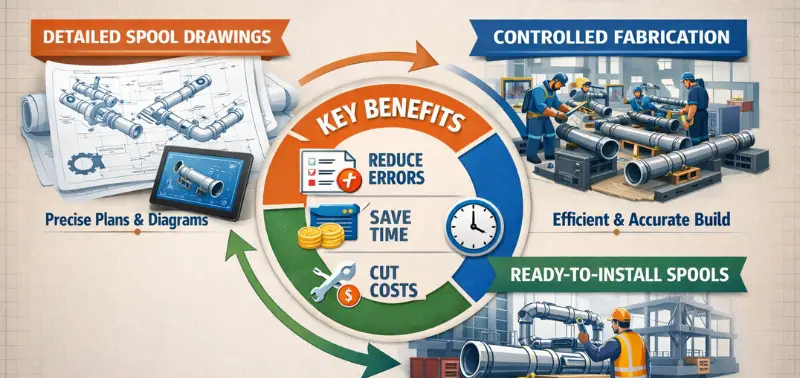
Construction projects move faster when teams fabricate building components before they reach the site. But speed alone does not create value. Accuracy does. If a prefabricated section arrives with the wrong size, wrong connection, or wrong sequence, the project loses time, labor, and money. That is why spool drawings matter. Spool drawings improve prefabrication accuracy in construction by turning complex building systems into smaller, fabrication-ready sections that are easier to understand, manufacture, inspect, transport, and install. They reduce guesswork in the shop, improve clarity for field teams, and help contractors deliver work with fewer errors and less rework. In modern construction, where contractors want tighter schedules, cleaner coordination, and better productivity, spool drawings are not just technical documents. They are a practical tool for building smarter.
What Are Spool Drawings?
Spool drawings are detailed drawings created for a specific portion of a larger building system. Instead of showing an entire network of pipes, ducts, conduits, or structural components on one broad drawing, they isolate one manageable section that can be fabricated as a unit. Think of them as production-level instructions. A spool drawing usually shows the exact segment to be fabricated, its dimensions, the type of fittings or connections involved, identification tags, orientation, and references for how that section fits into the overall system. This makes it easier for the fabrication team to build the right piece without relying on assumptions. In projects that use prefabrication heavily, spool drawings help bridge the gap between design intent and shop-floor execution.
Why Prefabrication Accuracy Matters
Prefabrication promises faster timelines, reduced site congestion, better labor efficiency, and improved quality control. But none of those benefits hold up when the fabricated pieces are inaccurate. A small dimensional mistake in the shop can become a major installation problem in the field. A missing connection point can hold up multiple trades. A poorly labeled assembly can slow down site crews that are already working under pressure. Accuracy matters because every prefabricated component must fit the real jobsite conditions. It must connect properly, align with adjacent systems, and arrive in the right sequence. That level of control is difficult to achieve with general drawings alone. Spool drawings improve that control by focusing on buildable sections instead of broad design packages.’’
How Spool Drawings Improve Prefabrication Accuracy in Construction
1. They Turn Complex Systems Into Buildable Pieces
Large construction systems are difficult to fabricate accurately when viewed as one continuous network. Mechanical, plumbing, electrical, and fire protection (MEPF) layouts often cross multiple zones, elevations, and trades. Fabricating directly from large plan sets increases the chance of missed details. Spool drawings simplify that complexity. They divide the system into smaller sections that make sense for fabrication and installation. Each spool becomes a defined package with a clear scope. This helps the shop focus on one exact assembly at a time instead of interpreting an entire system all at once. When work becomes easier to understand, it becomes easier to fabricate accurately.
2. They Reduce Misinterpretation in the Shop
One of the biggest reasons prefab errors happen is not poor workmanship. It is unclear information. Fabricators need more than design drawings. They need production-ready instructions. If the documents leave room for interpretation, different people may read the same drawing in different ways. That leads to wrong cuts, wrong fittings, wrong orientations, and avoidable rework. Spool drawings reduce this risk by giving the fabrication team a much clearer picture of what needs to be built. They make the drawing package more direct, focused, and actionable. Instead of asking the shop to interpret a broad layout, they present one defined section with the information needed to build it correctly. That clarity is one of the strongest reasons spool drawings improve prefabrication accuracy in construction.
3. They Improve Dimensional Precision
Dimensional control is everything in prefabrication. A prefabricated assembly must fit exactly where it is intended to go. If it is too long, too short, offset incorrectly, or misaligned at the connections, the field crew will need to modify it on site. That defeats the purpose of prefabrication. Spool drawings improve dimensional precision by isolating specific assemblies and showing the measurements that matter for fabrication. They support tighter control over cut lengths, fitting placements, elevations, offsets, and connections. This level of precision helps fabricators produce assemblies that match coordinated design conditions more closely, which leads to smoother installation later.
4. They Support Better Coordination Between Trades
Prefabrication does not happen in isolation. Every system in a building shares space with something else. A duct run may pass near cable trays. A pipe spool may sit above lighting supports. A prefabricated corridor rack may need exact clearance from walls, ceilings, and equipment. If those conditions are not coordinated properly before fabrication begins, the finished spool may not fit the site conditions. Spool drawings help contractors lock down coordination at a more practical level. Because they represent buildable sections, they make it easier to review how each assembly will fit in the real construction environment. This becomes even more powerful when spool drawings are developed from a coordinated BIM model. The more clearly teams coordinate before fabrication, the more accurate the final assembly becomes.
5. They Improve Material Control
Accuracy in prefabrication is not only about geometry. It is also about the right materials reaching the right spool at the right time. When assemblies are not clearly organized, materials can be grouped incorrectly, released too early, or missed entirely. That creates confusion in the shop and delays production. Spool drawings improve material control by organizing fabrication around defined units. Each spool can be linked to specific components, counts, tags, and release packages. This makes it easier to track what belongs to each assembly and avoid mix-ups during cutting, assembly, and dispatch. Better material control leads to cleaner fabrication workflows and fewer errors that come from missing or mismatched parts.
6. They Make Quality Checks Easier
You cannot improve accuracy if you cannot inspect the work properly. Spool drawings make QA and QC more practical because they define exactly what should be built. Reviewers can compare the fabricated assembly against a clear drawing package instead of trying to judge it against a crowded, full-system layout. This helps teams verify dimensions, part placement, tags, and connections before the spool leaves the shop. Catching these issues in fabrication is far cheaper than correcting them on site. In other words, spool drawings make quality control more targeted. And when quality checks become more precise, accuracy improves.
7. They Improve Installation Accuracy in the Field
Prefabrication does not end in the shop. The real test is whether the assembly fits and installs correctly on site. Spool drawings help field teams because they provide identification, orientation, and assembly references that make installation faster and more reliable. Installers can understand where the spool belongs, how it connects, and in what sequence it should be placed. That reduces hesitation in the field. It also reduces the risk of placing the wrong section in the wrong location. When site teams install prefabricated assemblies without needing major adjustments, the value of spool drawings becomes obvious. They do not just improve fabrication accuracy. They improve project execution.
8. They Reduce Rework and Waste
Rework is one of the most expensive problems in construction. A spool that must be cut, modified, rebuilt, or reordered creates direct labor loss and indirect schedule pressure. It can also affect adjacent trades and create ripple effects across the project. Spool drawings reduce rework because they support better planning, clearer fabrication, and more reliable installation. They help teams solve problems before material is cut and before assemblies are shipped. That means less scrap, fewer rushed corrections, and better use of skilled labor. For contractors looking to improve productivity, this is a major advantage.
Common Problems When Spool Drawings Are Poor or Missing
Projects feel the impact quickly when spool drawings are incomplete, poorly organized, or skipped altogether. Common issues include:
- prefabricated sections that do not fit the actual site conditions
- incorrect dimensions or connection points
- mislabeled assemblies
- missing parts in the spool package
- installation delays caused by confusion in the field
- higher labor cost due to on-site adjustments
- more RFIs and back-and-forth between teams
These issues slow down the very workflow prefabrication is supposed to improve.
Best Practices for High-Accuracy Spool Drawings
Contractors, BIM teams, and fabrication partners get better results when they treat spool drawings as a production tool, not just another documentation step.
Here are the practices that help most:
Start with a well-coordinated model
Spool drawings should come from coordinated information. If the base model is full of unresolved clashes or missing details, the spool package will carry those problems into fabrication.
Define spool boundaries logically
Each spool should reflect how the assembly will actually be built, transported, and installed. Poor spool boundaries create confusion and make handling harder.
Keep labeling consistent
Spool numbers, tags, and references should follow a clear system so the shop and field teams can track assemblies without confusion.
Include fabrication-relevant detail
A spool drawing should not overload the page, but it must show everything needed to build the assembly correctly.
Review before release
The best time to catch errors is before fabrication starts. A disciplined review process improves quality and prevents expensive mistakes.
Align spooling with site sequence
The most accurate spool is still a problem if it arrives at the wrong time. Good spool planning should support installation order and site logistics.
Where Spool Drawings Add the Most Value
Spool drawings are especially useful in projects where systems are dense, repetitive, or difficult to install in the field.
They bring strong value in:
-
- MEP prefabrication
- piping and plumbing systems
- fire protection systems
- HVAC duct fabrication
- corridor rack prefabrication
- plant and industrial construction
- modular and offsite construction
- data centers, hospitals, and large commercial buildings
In these environments, precision is critical and field space is limited. That makes spool-level control far more valuable.
Spool Drawings vs Shop Drawings
Many people use these terms together, but they are not exactly the same. Shop drawings usually show how a trade system or component should be manufactured or installed from a broader perspective. Spool drawings go a step further by isolating smaller fabrication-ready sections within that larger scope.
- Shop drawings help explain the system.
- Spool drawings help build it in pieces.
That difference is why spool drawings play such an important role in prefabrication accuracy.
Final Thoughts
Spool drawings improve prefabrication accuracy in construction because they make complex work easier to fabricate, easier to inspect, and easier to install. They help contractors move from design intent to buildable reality. They reduce confusion in the shop, tighten dimensional control, improve coordination, support better quality checks, and lower the chances of field rework. In fast-moving projects where every hour and every installation window matters, that level of accuracy is not optional. It is a competitive advantage. If your construction workflow depends on offsite fabrication, modular delivery, or trade coordination, investing in clear and well-developed spool drawings can directly improve productivity, quality, and project outcomes.