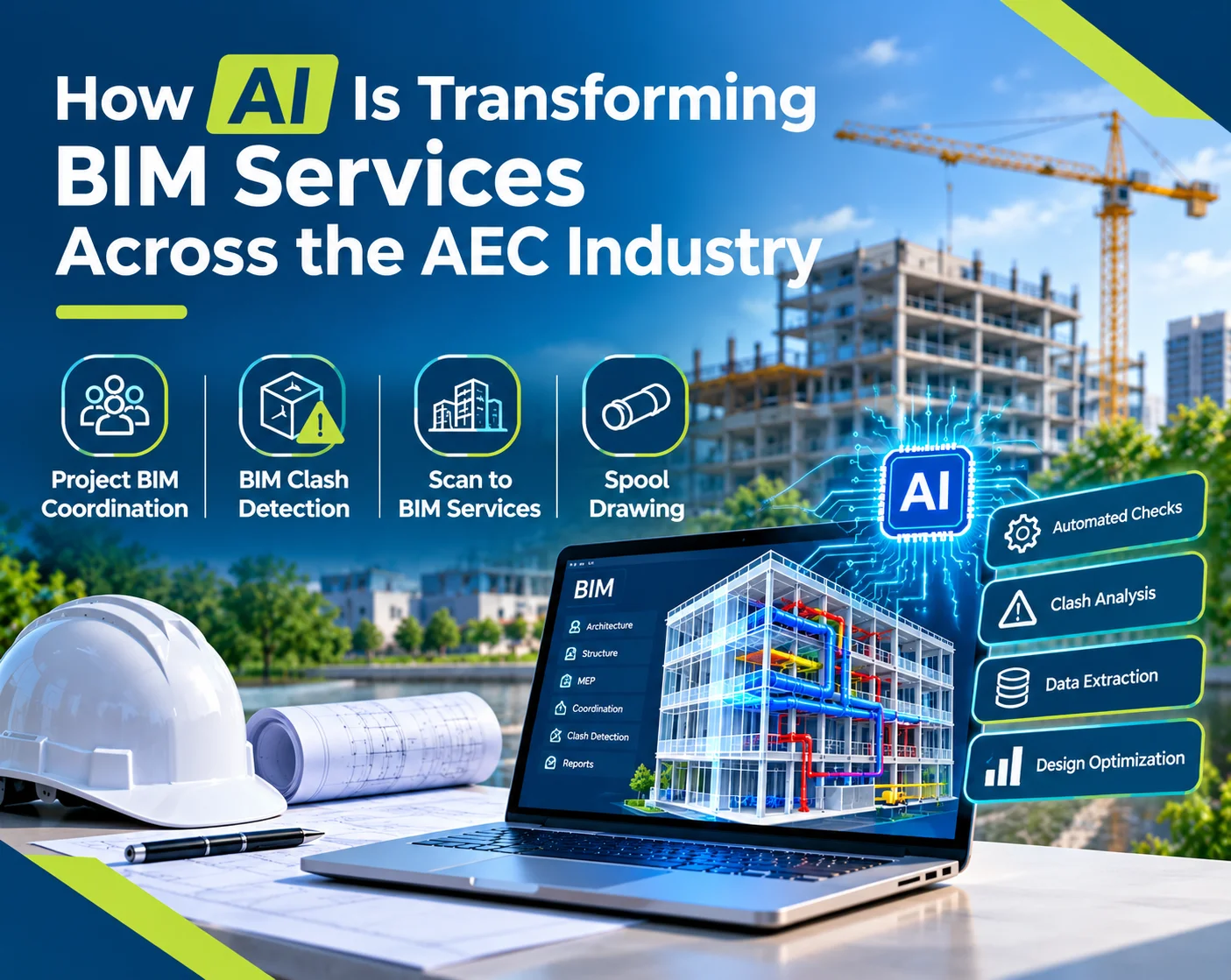
AI in BIM Services is changing how AEC teams model, check and hand over buildings, though the shift is more practical than dramatic. Instead of replacing the people who build models, these tools sort through thousands of elements, flag odd data and point reviewers toward problems worth their time. That support matters most on multidisciplinary jobs, where BIM coordination services keep design, trade and field information aligned, and where Project BIM Coordination depends on clean, current data.
Consider a mid-rise hospital with architectural, structural and MEP models updated every week. Reviewing each change by hand is slow, and AI in BIM Services lets teams compare model versions, spot missing parameters and catch naming errors before they reach the field. The coordinator still decides what matters. The software simply shortens the search.
BIM Clash Detection shows why the word “AI” needs some care. A basic clash test is rule-based automation: it finds geometry that overlaps, nothing more. Machine learning adds a layer by grouping similar clashes and learning which ones earlier projects treated as serious. Generative tools and agentic assistants, which plan and run several connected steps, go further but are newer, so it helps to separate these categories when judging vendor claims about AI in BIM Services.
Data quality sets the ceiling. A model with inconsistent parameters, unclear naming or missing classifications will produce unreliable results, however advanced the tool. Strong AI in BIM Services therefore starts with a BIM execution plan, shared standards, interoperable formats such as IFC, and a person who verifies the output.
AI in BIM Services also reaches beyond new construction. Renovation teams face an older problem: nobody is sure what is actually above the ceiling. Point cloud classification can separate walls, slabs, pipes and ducts faster than manual tracing, which is why interest in Scan to BIM Services keeps growing.
Documentation is the quieter win. A contractor preparing quantity takeoffs, for example, can use AI-assisted extraction to organize material data and highlight elements missing dimensions or classifications. Applied across AI in BIM Services workflows, those checks cut the back-and-forth that normally eats review time, though estimators still confirm quantities before anything is priced.
Spool Drawing services show both the promise and the limits. Automated tools can organize pipe segments, tag fittings and flag missing data, but fabrication dimensions need an engineer’s sign-off. The sections below cover coordination, modeling, clash review, existing buildings, documentation and what comes next, so you can judge where AI in BIM Services fits your projects.
Project BIM Coordination: Where AI Supports Multidisciplinary Teams
On a typical commercial job, architectural, structural and MEP models arrive from different consultants in different states of completion. Automated checks can compare them against project rules, flag inconsistent data and track what changed since the last issue. Picture an MEP team whose duct fittings lack system-name parameters: a check lists every affected instance in minutes, and the coordinator assigns fixes instead of hunting for them. Issues can then be ranked by trade, level and schedule impact, so design-change reviews move faster. Constructability, access and sequencing remain the coordinator’s call.
How AI in BIM Services Is Changing Modeling and Design Workflows
Repetitive modeling is where assistance shows up first. Tools can place standard elements from a defined rule set, assign parameters and classify components to match project standards, while model validation catches elements that break those rules. Generative design can propose layout alternatives against stated constraints such as clearances or floor area, and documentation support can draft tags and schedules. None of this produces a construction-ready model alone. It frees BIM modelers to spend more time on complex routing, engineering decisions and design intent.
| BIM Activity | Traditional BIM Workflow | AI-Assisted BIM Workflow |
|---|---|---|
| Modeling | Manual creation and parameter entry | Assisted placement and data classification |
| Coordination | Manual model reviews | Automated checks and issue ranking |
| Clash Detection | Reading long clash reports | Grouping and prioritization |
| Scan to BIM | Manual point cloud interpretation | Classification and element recognition |
| Documentation | Manual drawing and data checks | Automated consistency checks |
| Quantity Takeoffs | Manual extraction and calculation | Assisted extraction and validation |
AI-Assisted BIM Clash Detection and Quality Control
A coordinator opens a report with several hundred clashes. Many are duplicates, since one misplaced beam sleeve can trigger dozens of entries. AI-assisted grouping bundles them, and prioritization lifts serious conflicts, such as an HVAC duct cutting through a transfer beam, above minor ones like a conduit grazing a ceiling grid. Recurring errors, such as plumbing pipelines modeled without insulation clearance, can be traced across models, and historical project data may suggest fixes that worked before. Still, these are suggestions, not decisions. AI does not resolve every clash, and an experienced coordinator checks access, code requirements and installation sequence before any change is approved.
Also Read: Top 10 Ways to Prevent Common Error – BIM Model Accuracy
The Role of AI in BIM Services for Scan to BIM and Existing Buildings
A single scan can hold millions of points, and manual interpretation takes time. On a renovation project, AI-assisted classification can segment the cloud into floors, walls, columns, pipes and ducts, recognize repeated elements and extract dimensions for the model. Teams then spend effort on verification instead of first-pass tracing. Results depend on the scan: gaps, reflective surfaces and clutter reduce recognition accuracy. Modeling standards, tolerances and the required LOD must be set up front, and a modeler checks the finished geometry against the scan.
AI-Driven Documentation, Spool Drawing and Project Delivery
Models carry data that construction teams need, and AI can help extract it. Quantity takeoffs, material lists and equipment schedules can be pulled, organized and validated against the model. A BIM team can also compare an updated model with issued drawings to find discrepancies, such as a relocated riser that never reached the plan. For fabrication, extracted piping data supports planning by grouping segments and exposing missing information. Dimensions, tolerances and engineering requirements still need verification by qualified professionals before release. The gain is better information availability.
How AI in BIM Services Will Shape the Future of the AEC Industry
Some capabilities are already in daily use: rule-based checks, clash grouping, point cloud classification and data extraction. Others are still developing. Agentic AI, connected BIM workflows and AI-integrated digital twins are being piloted rather than standardized. Predictive analytics, automated progress monitoring against scans, construction risk identification and sustainability or building performance analysis all depend on dependable data and careful validation. The strongest results will come from teams where engineers, coordinators and modelers direct the tools and own the outcome.
Final Thoughts
AI is changing BIM workflows by reducing repetitive checking across modeling, coordination, clash review and documentation. Faster information handling, more consistent models and clearer priorities let teams spend time where judgment matters. It only works with reliable data, shared standards and engineering validation, because AI supports professionals and does not stand in for them. As adoption grows, AI-assisted processes will become a normal expectation in the AEC industry, and firms that pair them with experienced reviewers will deliver stronger Project BIM Coordination.