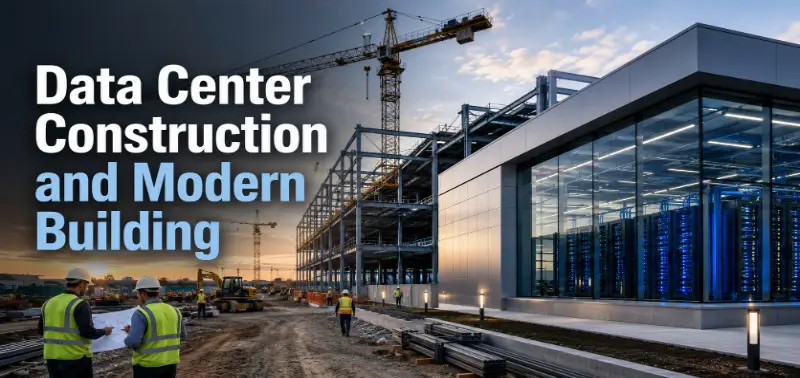
Data center construction is changing the way the construction industry thinks about speed, coordination, technology, and long-term building performance. These projects are not simple commercial buildings with server rooms inside. They are highly engineered, power-hungry, cooling-intensive, mission-critical facilities that must operate with little room for failure. Every data center supports something bigger than the building itself. It supports cloud platforms, artificial intelligence, financial systems, streaming services, online businesses, healthcare data, and enterprise operations. That means the project cannot be planned like an ordinary building. Every decision around design, power, cooling, procurement, equipment layout, BIM coordination, commissioning, and operations must connect from the beginning. This is why data centers are teaching the construction industry an important lesson: modern construction is no longer just about building faster. It is about building smarter, coordinating earlier, reducing uncertainty, and delivering projects as complete operating systems.
Key Takeaways
- Data center construction shows why early planning is critical for complex projects.
- Power availability, cooling demand, and long-lead equipment can shape the entire project schedule.
- BIM coordination helps teams detect conflicts before they become costly field issues.
- MEP coordination is one of the most important success factors in data center projects.
- Supply chain planning must begin early because electrical and mechanical equipment can delay the entire build.
- Commissioning should not be treated as a final step. It should influence design, coordination, and installation from the start.
- Data centers prove that construction teams need better collaboration between owners, architects, engineers, contractors, trades, vendors, and facility teams.
- The future of construction will depend on digital workflows, integrated delivery, and system-level thinking.
Why Data Center Construction Matters to the Entire Industry
Data centers are one of the clearest examples of where construction is heading. They are complex, fast-paced, equipment-heavy, and performance-driven. They also expose the weaknesses of traditional construction workflows. On many projects, teams still work in separate silos. Architects design. Engineers coordinate their systems. Contractors price the work. Trade contractors solve problems in the field. Commissioning teams enter near the end. Facility teams receive the building after handover. That approach creates delays, rework, RFIs, change orders, and avoidable coordination issues. Data center construction does not allow that level of disconnection. A missed clearance around electrical gear can affect installation. A delayed transformer can affect the schedule. Poor cooling coordination can affect performance. A weak commissioning plan can delay occupancy. A poorly structured BIM model can create confusion between design and field execution. The lesson is simple: complex buildings need connected workflows.
Data Centers Are Not Just Buildings — They Are Operating Systems
A data center must perform continuously. It depends on power systems, cooling systems, controls, fire protection, security, network infrastructure, backup equipment, and monitoring systems. These systems must work together from day one. That makes data center construction very different from basic commercial construction. A retail building, office space, or warehouse may still function even if some systems are adjusted during construction. But a data center cannot rely on last-minute fixes. The systems are too connected, and the cost of failure is too high.
In practical terms, this means construction teams must focus on:
- System reliability
- Equipment access
- Maintenance clearances
- Cooling efficiency
- Electrical redundancy
- Installation sequencing
- Prefabrication planning
- Testing and commissioning
- Future expansion capacity
- Accurate as-built documentation
This level of planning is not optional. It is the foundation of successful data center delivery.
Lesson 1: Early Planning Controls the Entire Project
In data center construction, the biggest decisions often happen before construction starts. Site selection, utility availability, power capacity, equipment procurement, cooling strategy, and project phasing can determine whether the project succeeds or struggles. Many construction delays begin because teams make major decisions too late.
For example:
- The site may not have enough available power.
- Utility upgrades may take longer than expected.
- Electrical equipment may have long manufacturing lead times.
- Mechanical systems may require more space than planned.
- Structural openings may not support final equipment routing.
- BIM coordination may begin after major design decisions are already fixed.
- Commissioning requirements may not be included early enough.
When these issues appear late, they cost more to fix. Data centers teach the industry that early planning must include every major project system. Owners, engineers, contractors, trade partners, vendors, BIM teams, and commissioning teams should align before design decisions become difficult to change.
Lesson 2: Power Strategy Is a Project Driver
Power is one of the biggest challenges in data center construction. A data center cannot operate without a stable and scalable power supply. That makes electrical planning one of the first and most important parts of the project.
Power planning affects:
- Site feasibility
- Utility coordination
- Equipment procurement
- Generator layout
- Switchgear rooms
- UPS systems
- Cable tray routing
- Cooling demand
- Backup power strategy
- Future expansion planning
This is a major lesson for all types of construction projects. Power should not be treated as a late-stage utility connection. It should be part of early feasibility and master planning. For hospitals, industrial plants, manufacturing facilities, laboratories, and large commercial campuses, power planning can shape the entire building strategy. If the electrical infrastructure is not properly planned, the project may face delays, redesign, and performance issues.
Lesson 3: MEP Coordination Can Make or Break the Project
Data centers are heavily dependent on mechanical, electrical, plumbing, fire protection, and control systems. These systems fill large portions of the building and often compete for the same space. This makes MEP coordination one of the most important parts of data center construction.
A small coordination issue can create major field problems. For example:
- Cable trays may clash with ductwork.
- Pipe routes may block maintenance access.
- Mechanical equipment may not have enough service clearance.
- Fire protection systems may conflict with electrical routing.
- Structural beams may block overhead systems.
- Equipment may not fit through planned access paths.
- Installation sequencing may fail because systems were modeled without field logic.
This is where BIM coordination becomes extremely valuable. A strong BIM coordination process helps the team:
- Detect clashes before installation
- Coordinate trade routing
- Validate access and clearance requirements
- Improve shop drawing accuracy
- Support prefabrication
- Reduce field rework
- Improve communication between design and construction teams
- Create a cleaner path to commissioning and handover
For data centers, BIM is not just a visual model. It is a construction coordination tool.
Lesson 4: BIM Must Support Real Construction Decisions
Many projects use BIM only to create 3D models or satisfy design requirements. Data center construction shows that this is not enough. The model must help the team make better decisions.
A useful BIM model should answer practical questions such as:
- Can the equipment be installed safely?
- Does every system have enough space?
- Are access clearances properly maintained?
- Can prefabricated assemblies fit into the building?
- Are cable trays, ducts, pipes, and supports coordinated?
- Will maintenance teams be able to reach key equipment?
- Does the construction sequence work in the real field environment?
- Can the model support accurate as-built documentation?
When BIM is used properly, it reduces uncertainty. It allows contractors and owners to identify problems before they become expensive site issues. This is one of the biggest lessons data centers offer to the construction industry: BIM should not stop at modeling. It should support coordination, planning, sequencing, prefabrication, cost control, and facility handover.
Lesson 5: Supply Chain Planning Must Start Earlier
Data center projects depend on major electrical and mechanical equipment. Many of these items have long lead times and limited supplier availability.
Common long-lead items include:
- Transformers
- Switchgear
- Generators
- UPS systems
- Cooling equipment
- Chillers
- CRAH or CRAC units
- Electrical panels
- Busways
- Control systems
- Specialty fire protection systems
If these items are delayed, the project schedule can quickly become unrealistic. This teaches a major construction lesson: procurement is not separate from design. Procurement must connect with design, BIM coordination, scheduling, and site planning. For example, if a switchgear package changes, it may affect room layout, clearances, cable routing, structural supports, and installation sequencing. If that update does not flow through the BIM model and construction plan, the team may face costly rework. Modern construction teams need better supply chain visibility. They also need stronger communication between design consultants, procurement teams, vendors, contractors, and BIM coordinators.
Lesson 6: Standardization Helps Improve Speed and Quality
Data center construction often uses repeatable design strategies, modular planning, prefabricated systems, and standardized equipment layouts. This approach helps teams reduce mistakes and speed up delivery. Standardization does not mean every project becomes identical. It means the team creates reliable systems that can be repeated where appropriate.
Construction teams can standardize:
- BIM templates
- Revit family libraries
- Clash detection rules
- Equipment clearance standards
- Sheet setup and drawing formats
- MEP coordination workflows
- Prefabrication details
- QA/QC checklists
- Naming conventions
- Commissioning documentation
- Handover data requirements
This saves time because teams do not need to recreate the same process on every project. For BIM and construction firms, this is a major opportunity. A strong internal standard improves consistency, reduces coordination errors, and helps teams deliver more predictable results.
Lesson 7: Prefabrication Works Best When BIM Is Accurate
Data centers are ideal projects for prefabrication because they include repeated systems, dense MEP layouts, and tight schedules. Prefabricated racks, skids, piping assemblies, cable tray modules, and equipment supports can reduce field labor and improve quality. But prefabrication only works when the model is accurate. If the BIM model is incomplete or poorly coordinated, prefabricated components may not fit on-site. That creates serious schedule and cost problems.
For prefabrication to work, teams need:
- Accurate field-verified dimensions
- Coordinated MEP routing
- Clear installation sequencing
- Proper access planning
- Reliable fabrication-level details
- Strong communication between modelers and field teams
- Early trade contractor involvement
- Clear spool drawings and shop drawings
Data centers prove that BIM and prefabrication must work together. A model that looks good but does not support fabrication is not enough.
Lesson 8: Commissioning Should Begin During Design
Commissioning is often treated as the final stage of construction. In data center projects, that mindset creates risk. A data center must be tested, validated, and proven before it can operate. Power systems, backup systems, cooling systems, controls, alarms, fire protection, and monitoring must all work together. If commissioning starts too late, the team may discover problems after installation is already complete.
That can lead to:
- Failed system tests
- Delayed handover
- Rework
- Missing documentation
- Poor access to testing points
- Controls integration problems
- Confusion between design intent and installed conditions
A better approach is to bring commissioning requirements into the project early.
The team should plan:
- Testing access
- Equipment documentation
- System performance requirements
- Sequence of operations
- Functional testing steps
- Commissioning schedule
- As-built model requirements
- Facility management data
This improves handover and helps the owner operate the facility with confidence.
Lesson 9: Construction Teams Must Think Beyond the Jobsite
Data center construction shows that project success depends on more than what happens on-site. It also depends on utility providers, equipment manufacturers, digital coordination, logistics, regulations, suppliers, and operations teams. This is why construction must become more integrated. A general contractor cannot solve every problem alone. An engineer cannot coordinate every field condition from drawings only. A BIM team cannot create value if it receives incomplete information. A commissioning team cannot fix poor planning at the end. Everyone must work from a shared understanding of the project.
Strong collaboration should include:
- Owners and developers
- Architects
- Structural engineers
- MEP engineers
- General contractors
- Trade contractors
- BIM coordinators
- Fabricators
- Vendors and suppliers
- Commissioning agents
- Facility management teams
- Utility providers
When these groups communicate early, projects move with fewer surprises.
Lesson 10: Digital Construction Is Now a Competitive Advantage
Digital construction is no longer just a nice upgrade. On complex projects, it is becoming a competitive advantage.
Data center construction benefits from digital workflows such as:
- BIM modeling
- Clash detection
- 4D scheduling
- 5D cost planning
- Digital twins
- Model-based coordination
- Cloud-based project collaboration
- Field verification tools
- Reality capture
- Digital commissioning records
- Asset information management
These tools help teams manage complexity. But the tool itself is not the full solution. The real value comes from how teams use digital information to make better decisions. A project does not become smarter just because it uses software. It becomes smarter when the team connects the model, schedule, cost, procurement, field execution, and handover process. That is the real future of digital construction.
What Other Construction Projects Can Learn from Data Centers
The lessons from data center construction apply to many other building types.
Healthcare projects need reliable power, complex MEP systems, infection control planning, and strict compliance.
Industrial facilities need equipment coordination, process piping, safety zones, utility planning, and phased installation.
Airports need strong coordination between structure, MEP, security, baggage systems, fire protection, and passenger flow.
High-rise buildings need vertical transportation planning, MEP riser coordination, fire safety systems, and efficient sequencing.
Commercial campuses need utility planning, future expansion strategy, digital documentation, and strong facility handover.
In all these projects, the message is the same: construction success depends on coordination, not just construction activity.
The Future of Construction Will Be More Connected
Data centers are pushing the construction industry toward a better way of working. They prove that old workflows cannot handle modern project complexity.
The future of construction will require:
- Earlier collaboration
- Better BIM coordination
- Stronger MEP planning
- Smarter procurement
- More prefabrication
- Improved commissioning
- Cleaner digital handover
- Better lifecycle asset data
- Stronger owner-contractor-vendor alignment
This shift is not only about technology. It is about mindset. Construction teams must stop treating design, procurement, coordination, installation, commissioning, and operations as separate phases. These phases are connected. A decision in one area affects every other part of the project. Data centers make this connection impossible to ignore.
Final Thoughts
Data center construction is teaching the construction industry how to handle the next generation of complex projects. These facilities demand speed, accuracy, reliability, coordination, and long-term performance. They also show why traditional construction methods are no longer enough. To deliver modern projects successfully, construction teams need to plan earlier, coordinate better, use BIM more intelligently, manage supply chains more carefully, and involve commissioning teams before the final stage. The biggest lesson is clear: construction is moving from project delivery to system delivery. Data centers are not just changing how technical buildings are built. They are setting a new standard for how all complex construction projects should be planned, coordinated, and delivered.