Renovation projects rarely begin with perfect information. Existing drawings may be outdated, site conditions may have changed over time, and hidden field issues often create problems once work starts. That is why 3D laser scanning for renovation projects has become such a practical tool in modern construction. Instead of relying only on manual measurements and old documentation, project teams can capture the actual built environment with precision and turn that information into a reliable digital reference. This gives architects, engineers, contractors, and owners a clearer view of what already exists before demolition, redesign, coordination, or installation begins. For commercial buildings, residential properties, and industrial facilities, 3D scanning creates a stronger foundation for planning and execution. When the scan data is used in BIM workflows, teams can model existing conditions more accurately, coordinate with greater confidence, and reduce costly surprises in the field.
What Is 3D Laser Scanning in Renovation?
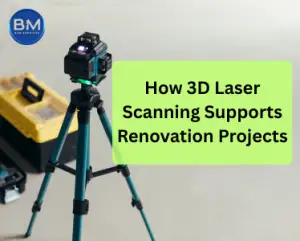
3D laser scanning is the process of capturing the geometry of an existing building or space using advanced scanning equipment. The scanner records millions of data points from walls, ceilings, floors, columns, piping, ductwork, equipment, and other visible elements. This data becomes a point cloud, which can then support accurate modeling and renovation planning. In renovation work, this matters because the project depends on what is already built. If the field data is incomplete or inaccurate, design decisions can go wrong. That often leads to clashes, delays, rework, and installation issues once construction begins. This is why many teams use scanning and BIM support across commercial, residential, and industrial renovation work. It helps them start with facts instead of assumptions.
Why 3D Laser Scanning Matters for Renovation Projects
Renovation is different from new construction. In a new build, teams work from a more controlled environment. In renovation, they must adapt to existing conditions that may not match the drawings. Walls may be out of place, slab elevations may vary, ceilings may be congested, and systems may have been modified over the years. 3D laser scanning for renovation projects helps reduce that uncertainty by capturing the true field conditions before major decisions are made.
It offers clear benefits:
- Captures existing conditions with a high level of detail
- Reduces reliance on outdated drawings
- Helps teams model what is actually in place
- Supports better coordination before installation
- Improves planning in occupied or complex spaces
- Reduces rework, delays, and field conflicts
In simple terms, it gives the team a more dependable starting point.
How the Process Works
A typical renovation scanning workflow begins with a site visit. The building or target area is scanned to capture real-world conditions. The data is then processed into a point cloud and used to create a digital model of the existing structure or systems. From there, the model can support design updates, coordination, demolition planning, layout checks, and as-built documentation.
A common workflow looks like this:
- Existing site conditions are captured with 3D laser scanning
- Point cloud data is processed and organized
- Architectural, structural, or MEP elements are modeled from the scan
- The model supports redesign and coordination
- The team reviews potential conflicts before field work starts
- Final documentation becomes more accurate and useful
This process improves the connection between field reality and project planning.
Benefits for Commercial Renovation Projects
Commercial renovation projects often involve tight schedules, phased work, and multiple stakeholders. Office buildings, retail spaces, hotels, schools, and mixed-use properties usually need upgrades without major disruption. In these projects, poor field data can quickly affect schedule and budget. 3D laser scanning helps commercial teams understand layouts, ceiling spaces, service zones, and MEP congestion before design work moves too far ahead. It is especially useful for tenant improvements, code upgrades, interior reconfiguration, and system replacements. With better existing conditions data, project teams can coordinate more accurately, reduce surprises during demolition, and improve installation planning in active commercial spaces.
Benefits for Residential Renovation Projects
Residential renovation can look simple at first, but existing homes often contain hidden complexity. Older houses may have undocumented changes, shifted walls, uneven framing, additions, and limited space for upgraded systems. Manual measurements can miss details that matter later. 3D laser scanning gives residential teams a more dependable base for remodeling, additions, restoration, and interior redesign. Designers can work from accurate dimensions, and contractors can better understand existing conditions before demolition or installation begins. This is especially helpful in custom homes, historic renovations, kitchen and bath remodels, and projects involving detailed millwork or complex MEP upgrades.
Benefits for Industrial Renovation Projects
Industrial renovation is one of the strongest use cases for 3D laser scanning. Plants, warehouses, manufacturing facilities, and utility spaces often contain dense piping, equipment, structure, and cable routes. These environments may have changed many times without complete documentation. Scanning helps teams capture the actual layout before equipment replacement, expansion, retrofitting, or shutdown work begins. That makes it easier to plan tie-ins, coordinate new systems, and understand space limitations before fabrication or installation. For industrial projects, the value is not only about accuracy. It is about reducing field risk. Better data leads to better planning, fewer clashes, less wasted fabrication, and smoother execution in active facilities.
How 3D Laser Scanning Supports BIM Workflows
3D laser scanning becomes even more useful when it feeds into BIM. A model built from point cloud data can help teams move from site capture to real project decisions with greater clarity.
That model can support:
- Existing conditions modeling
- Design coordination
- Clash detection
- Shop drawing development
- Retrofit planning
- Prefabrication support
- As-built documentation
- Facility record updates
This is why many owners, architects, general contractors, and trade contractors use scan-based BIM workflows during renovation. It improves collaboration and creates a more accurate digital reference for the project team.
Common Problems 3D Laser Scanning Helps Prevent
Many renovation issues begin with incomplete information. Teams make assumptions about wall locations, overhead space, slab levels, structural members, or equipment sizes, then discover the real conditions too late.
3D laser scanning helps reduce problems such as:
- Design based on outdated documents
- Incorrect dimensions during planning
- MEP clashes in ceiling and service areas
- Fabrication errors caused by poor field data
- Delays from redesign and rework
- Budget increases tied to hidden conditions
- Installation issues in tight existing spaces
It will not remove every challenge, but it gives the team much better visibility before construction moves ahead.
When Should You Use 3D Laser Scanning for a Renovation Project?
3D laser scanning is most useful when the existing building conditions are complex, poorly documented, congested, or critical to project decisions.
It is a strong fit when:
- The building is older and drawings are unreliable
- The renovation includes major MEP changes
- Structural modifications or additions are planned
- The site is occupied or difficult to measure manually
- Shop drawing or prefabrication accuracy is important
- The owner needs reliable as-built records
If the success of the project depends on understanding what is already there, scanning is a smart move early in the process.
Why Early Accuracy Saves Time and Money
Some teams still see scanning as an extra step, but in renovation work, the real cost usually comes later. Field conflicts, redesign, wasted material, schedule delays, and labor inefficiency often cost far more than capturing accurate site data at the beginning. When teams start with dependable existing conditions, they can coordinate better, fabricate more confidently, and make better decisions before work reaches the field. That is where the real value of 3D laser scanning shows up. It is not just about collecting data. It is about reducing risk and improving execution.
Conclusion
Renovation success depends on understanding the existing building clearly before major work begins. That is why 3D laser scanning for renovation projects has become such an important part of modern construction planning. It captures real-world conditions with accuracy, supports stronger BIM workflows, and helps reduce the guesswork that often leads to delays and rework. In renovation, accurate existing conditions are not optional. They are the foundation for better decisions and better outcomes.