Construction projects rarely fail because of one big problem. Most of the time, trouble starts with a series of smaller risks that were either missed, underestimated, or pushed aside until they became expensive. A delayed material delivery turns into labor downtime. An unclear scope becomes a change order dispute. A missed coordination issue becomes rework in the field. That is exactly why construction risk management matters. For contractors, risk management is not just a paperwork exercise. It is a practical system for protecting budget, schedule, safety, quality, and client trust. When it is done right, it helps teams make better decisions before problems grow into claims, delays, and cost overruns. This guide explains how construction risk management works in real project conditions, what kinds of risks contractors should watch for, and how to build a process that actually helps on the jobsite.
What Is Construction Risk Management?
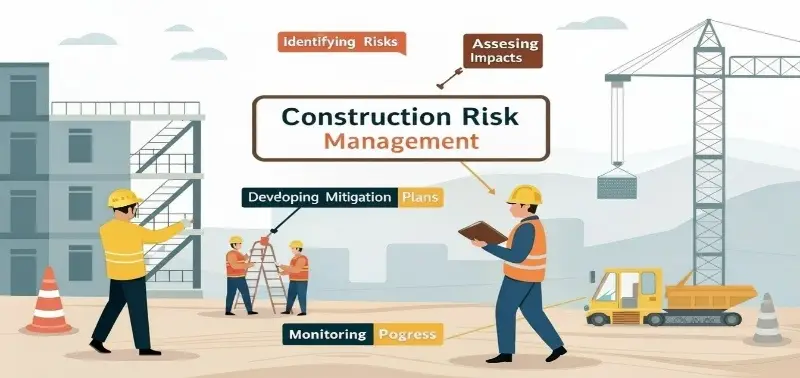
Construction risk management is the process of identifying, analyzing, controlling, and tracking risks that could affect a project. These risks can involve money, labor, design coordination, contracts, site safety, weather, materials, permits, or subcontractor performance.
In simple terms, it means asking practical questions throughout the project:
- What can go wrong?
- How likely is it to happen?
- How serious will the impact be?
- Who is responsible for watching it?
That is the working core of construction risk management. It is not about eliminating every risk. That is not realistic. It is about seeing risk early, ranking it properly, and responding before it damages the project.
Why Risk Management Matters for Contractors
Contractors operate in one of the most unpredictable environments in business. Every job includes moving parts, shifting site conditions, multiple trades, changing client expectations, and outside factors that nobody can fully control. Without a risk management process, teams often react too late.
A practical risk management approach helps contractors:
- reduce unexpected costs
- avoid schedule slippage
- improve site safety
- manage subcontractor and supplier issues
- strengthen bid accuracy
- limit disputes and claims
- improve project outcomes and client confidence
It also helps companies protect margins. A project can look profitable at the start and still lose money if risks are poorly managed. A missed coordination issue, a procurement delay, or a contract clause that shifts responsibility can quickly eat into profit.
The Main Types of Construction Risks
Not all project risks look the same. Some start in preconstruction. Others show up during execution. The smartest contractors do not focus only on safety or only on cost. They look at risk across the full project lifecycle.
1. Financial Risks
Financial risk is one of the biggest concerns for contractors. It includes underbidding, cash flow problems, rising material prices, delayed payments, incorrect takeoffs, and scope gaps that affect profitability. For example, if material pricing changes after the estimate is prepared and the contract does not protect against escalation, the contractor may absorb the extra cost. On a large project, that can seriously reduce margin.
2. Schedule Risks
Every contractor knows that lost time creates pressure. Schedule risks include labor shortages, procurement delays, poor sequencing, permit delays, weather disruption, late approvals, and rework from coordination issues. A schedule issue rarely stays isolated. It usually leads to overtime, trade stacking, rushed decisions, and quality problems.
3. Safety Risks
Construction safety risks are always critical. These include fall hazards, electrical exposure, equipment incidents, confined spaces, lifting operations, and unsafe site practices. A strong safety culture is part of risk management, not separate from it. Safety incidents affect people first, but they also affect schedule, insurance costs, compliance, reputation, and project continuity.
4. Contractual and Legal Risks
Contracts can create serious risk when scope language is vague, responsibilities are poorly defined, or notice requirements are missed. Contractors also face legal exposure from code violations, noncompliance, claims, and disputes over delays or defective work. Many project problems grow worse because teams do not fully understand contract obligations at the start.
5. Design and Coordination Risks
Inaccurate drawings, incomplete design information, trade clashes, and poor coordination can all trigger field conflicts. These risks are especially important on MEP-heavy, healthcare, industrial, and mission-critical projects where systems are tightly packed. This is where coordination tools, model reviews, clash detection, and constructability checks become valuable. They do not remove risk by themselves, but they help teams catch issues before installation.
6. Operational Risks
Operational risks come from day-to-day project execution. These include poor communication, missing documentation, equipment breakdowns, low productivity, weak supervision, and subcontractor underperformance. These may seem routine, but they often create the hidden losses that make projects harder to control.
7. External Risks
Some risks come from outside the contractor’s direct control. Weather events, regulatory changes, utility conflicts, economic shifts, labor market issues, and supply chain disruption all fall into this category. Even though contractors cannot stop these issues, they can still plan for them.
How Construction Risk Management Works Step by Step
A strong risk management process is simple enough to use, but structured enough to guide action. Here is how it works in practice.
Step 1: Identify Risks Early
Risk management starts before field work begins. The earlier a contractor identifies risks, the more options they have to reduce the impact.
Risk identification usually happens during:
- bid review
- preconstruction planning
- design review
- subcontractor evaluation
- schedule development
- procurement planning
- site assessment
At this stage, the project team should review drawings, specs, contract terms, site conditions, owner expectations, and sequencing assumptions. They should ask where the project is most exposed.
Useful questions include:
- Are the drawings fully coordinated?
- Are long-lead items already known?
- Are site access and logistics realistic?
- Are permit timelines clear?
- Are scope gaps likely between trades?
- Are there unusual safety or compliance issues?
- Are subcontractors capable and properly staffed?
The goal is not to create a long list with no follow-up. The goal is to identify real threats that could affect delivery.
Step 2: Assess Likelihood and Impact
Once risks are identified, the next step is to assess them. Contractors usually evaluate each risk based on two factors:
- likelihood of happening
- level of impact if it happens
A simple risk matrix works well here. Some risks are high likelihood and high impact, which means they need immediate attention. Others may be low likelihood but still high impact, such as a major safety incident or a major equipment failure.
For example:
- a routine weather delay may be moderate likelihood and moderate impact
- a major design coordination failure in a congested MEP room may be high likelihood and high impact
- a rare legal dispute may be low likelihood but high impact
This ranking helps teams focus on the risks that matter most instead of treating every issue the same way.
Step 3: Develop a Risk Response Plan
After assessing risk, the contractor decides how to respond. Most responses fall into four categories:
Avoid the Risk
Change the approach so the risk does not happen.
Example: revise sequencing to avoid trade congestion in a tight work area.
Reduce the Risk
Take steps to lower the likelihood or impact.
Example: perform coordination reviews and clash detection before fabrication.
Transfer the Risk
Shift some responsibility through insurance, subcontract terms, or supplier agreements.
Example: require proper coverage and clear scope responsibility in subcontracts.
Accept the Risk
Some risks cannot be fully prevented and may be accepted if the impact is manageable.
Example: minor weather variability with contingency built into the schedule. The response plan should also assign ownership. Every major risk needs someone responsible for tracking it. If nobody owns it, it usually gets ignored until it becomes urgent.
Step 4: Put Controls in Place
Risk management only works when the response plan turns into action. This is where control measures matter.
Common construction risk controls include:
- detailed scope reviews before award
- subcontractor prequalification
- clear RFIs and submittal tracking
- long-lead procurement planning
- jobsite safety plans
- contingency budgets
- schedule buffers for critical activities
- coordination meetings with trades
- progress tracking and reporting
- quality inspections and checklists
- digital model reviews and clash detection
Controls should be practical. A contractor does not need a complicated system that nobody uses. They need a process that field teams, project managers, estimators, and leadership can follow consistently.
Step 5: Monitor Risks Throughout the Project
Risk management is not a one-time meeting at the beginning of the job. Risks change as the project moves forward. New risks appear. Old risks become more serious. Some disappear.
That is why contractors should review risk regularly during:
- weekly project meetings
- procurement reviews
- safety meetings
- schedule updates
- owner coordination calls
- cost tracking reviews
For example, a long-lead procurement issue may start as a moderate concern in preconstruction, then become a major schedule risk if approvals are late. A small coordination problem may become a field rework issue if not resolved before installation. Ongoing monitoring keeps the team proactive instead of reactive.
What a Practical Risk Register Looks Like
A risk register is one of the most useful tools in construction risk management. It does not need to be fancy. It just needs to be clear and maintained.
A typical risk register includes:
- risk description
- category
- likelihood
- impact
- priority level
- mitigation action
- responsible party
- status
- review date
For example, a contractor might list:
Risk: Mechanical equipment lead time may exceed planned delivery window
Impact: Delayed installation and downstream schedule pressure
Response: Confirm release dates early, track submittal approval, communicate with supplier weekly
Owner: Project manager and procurement lead
That kind of visibility helps teams stay ahead of project issues.
Common Risk Management Mistakes Contractors Should Avoid
Even experienced contractors can weaken their results by making avoidable mistakes.
Treating risk management like paperwork
If risk planning only exists in a file and never reaches the field, it has no real value. Teams must use it in actual project decisions.
Focusing only on safety
Safety is critical, but project risk is broader than safety alone. Cost, schedule, design coordination, procurement, and contracts also need attention.
Waiting too long to escalate issues
Some project teams keep problems quiet too long because they hope conditions will improve. That usually makes the impact worse. Early escalation is often the smarter move.
Not involving the right people
Estimators, project managers, superintendents, coordinators, and key trade partners all see different parts of project risk. Good risk management needs input from multiple perspectives.
Ignoring documentation
Many disputes grow because teams failed to document decisions, notices, delays, approvals, or field conditions. Good records are one of the simplest ways to manage risk.
How Technology Supports Better Risk Management
Construction risk management is still a people-driven process, but technology helps teams spot and control problems faster.
Digital tools can support:
- schedule tracking
- document control
- cost reporting
- field issue management
- safety reporting
- model coordination
- clash detection
- as-built validation
- communication across teams
On more complex projects, BIM workflows can improve visibility into design and coordination risks. A coordinated model helps teams review constructability, identify clashes, and reduce installation conflicts before work begins in the field. That matters most when space is limited, systems are dense, or prefabrication depends on accurate information. Technology does not replace judgment, but it helps contractors make better decisions with better data.
Best Practices for Contractors
Contractors who manage risk well usually follow a few consistent habits. They start early instead of waiting for problems to show up. They review contracts carefully, not just drawings. They communicate openly with owners, designers, and trades. They track high-priority risks instead of spreading attention too thin. They document changes, delays, and decisions clearly. And they treat risk management as part of daily project leadership, not just compliance. The most effective teams also build lessons learned from one project into the next one. Over time, that creates a stronger process and a more resilient business.
Final Thoughts
Construction risk management works best when it is practical, visible, and tied to real project decisions. Contractors do not need a complicated framework that slows the team down. They need a repeatable process that helps them identify risk early, prioritize what matters, assign responsibility, and act before damage spreads. Every construction project carries uncertainty. That part will not change. But contractors who manage risk well are better prepared to protect their budgets, keep schedules moving, support safer jobsites, and deliver work with fewer surprises.