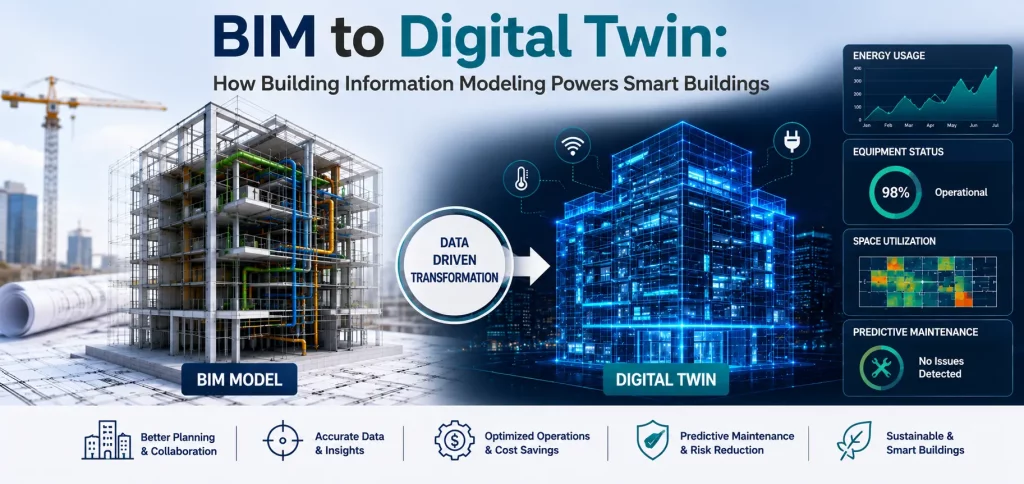
Go onto virtually any construction site these days, and there will be one term that you will keep hearing all the time, and that is BIM to Digital Twins. The concept of Building Information Modelling has for many years been used extensively in the world of digital construction, to design and construct better. However, there has been an evolution in the field of construction, and this has led to the advancement of BIM to Digital Twins.
Ever been curious how a 3D model designed and made before construction starts ends up being used to monitor temperature, energy consumption, and equipment condition several years later? This article describes the whole process step by step, in simple terms, making it relevant for architects, MEP engineers, facility managers, or anyone who is interested in the world of connected buildings.
What Exactly Is a BIM Model?
The basic idea of BIM technology is that it is basically a smart 3D model of the building. Not only does it consist of a visually appealing 3D image, but there is intelligence behind each element of the building such as walls, ducts, beams, etc. A good BIM model will include all design geometry, materials specifications, installation details, manufacturers data, etc.
Imagine it as a digital manual for your whole construction project. The architect uses it for coordinating the design, the engineer uses it for MEPF BIM services and clash detection, and the contractor uses it for sequencing. Nevertheless, once the construction phase comes to an end, the BIM model is then put away on the shelf and does nothing but serve as a reference material.
What Is a Digital Twins, Then?
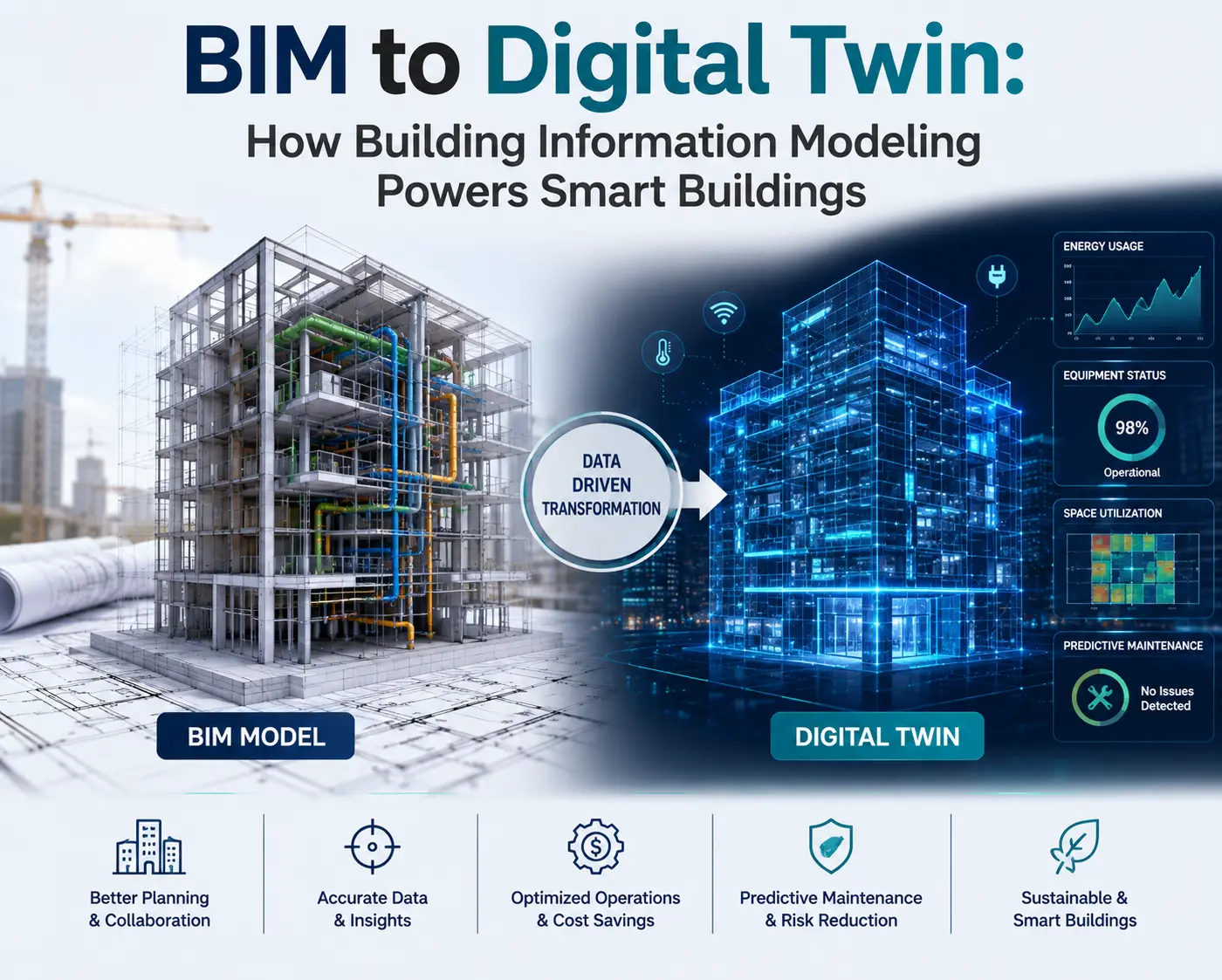
This is where the Digital Twins technology comes into play. The Digital Twins builds on top of the same 3D concept but adds dynamics to the process. It does not only create a model but actually provides a dynamic digital replica of the physical building, updated with data obtained from the real-life building continuously. Digital Twins technology implies a system which reflects the current processes in the building.
The core concept of smart buildings is based on this principle. Instead of passive blueprints, you end up with an interactive building which can tell its own state, kind of like a patient on a monitoring device, sharing all its important information with its caretakers.
BIM vs. Digital Twins: What’s the Real Difference?
It is hard to distinguish the two since a Digital Twins begins its existence as a BIM model. The distinctions should not be overlooked since they make sense when choosing to use Digital Twins architecture.
| Aspect | BIM Model | Digital Twins |
| Nature | Static, fixed at time of creation | Dynamic, updates continuously |
| Focus | Design and construction details | Day-to-day operations |
| Updates | Manual, project-based revisions | Automatic, sensor-driven |
| Lifecycle stage | Mostly design and construction phase | Entire building lifecycle |
| Data type | No live data | Real-time sensor data |
The BIM to Digital Twins Process, Step by Step
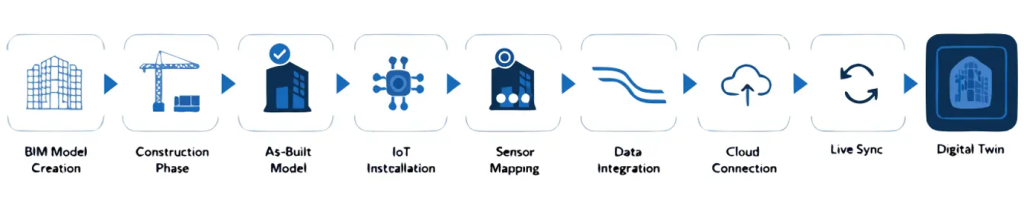
How does the static model get converted into a living digital twins? The process is quite logical despite some technical intricacies associated with it.
- BIM model creation: The project team builds a detailed 3D BIM model during design, capturing geometry, systems, and specifications.
- Construction phase: The model guides coordination, clash resolution, and sequencing on site as the building is physically constructed.
- As-Built BIM Model: Once construction finishes, the model is updated to reflect exactly what was built, not just what was planned.
- Installation of IoT devices: Sensors, meters, and smart controllers are installed throughout the building’s mechanical, electrical, and plumbing systems.
- IoT sensor mapping: Each sensor is linked to its matching object inside the BIM model using a unique ID.
- BIM data integration: The building’s asset data and sensor data are merged into a single connected dataset.
- Cloud platform connection: This combined data is pushed to a cloud platform where it can be processed and stored securely.
- Live data synchronization: The BIM model begins receiving continuous updates instead of sitting still.
- Building becoming a Digital Twins: Once live data flows constantly into the model, it officially functions as a Digital Twins, ready for real-time monitoring.
IoT Sensor Mapping: Connecting the Physical to the Digital
IoT sensor mapping is really the heart of the whole transformation. Every physical sensor, whether it’s monitoring a pump, a chiller, or a lighting circuit, gets tagged with a unique identifier that ties it to its digital twins inside the BIM model.
Here’s a simple example. Imagine clicking on an Air Handling Unit, or AHU, inside a BIM model connected to a live building. Instantly, you could see:
- Current temperature readings
- Airflow rates
- Energy consumption
- Total runtime hours
- Maintenance history
- Current alarm status
That’s the power of sensor integration done right. Instead of digging through spreadsheets or paper logs, facility teams get everything in one place, tied directly to the visual model they already understand.
Understanding Digital Twins Architecture
It is also important to think about the process of information transfer as a linear one. Here is the way data moves in the system from the physical building to its monitoring:

Sensors on the physical building collect information; the IoT gateway collects it and sends it further; the cloud platform processes it and stores it; the Digital Twins platform connects it to the BIM model. Finally, facility operators have access to real-time monitoring in their dashboard or Building Management System without visiting the building.
Predictive Maintenance: Catching Problems Before They Happen
One of the most valuable outcomes of this whole setup is predictive maintenance. Instead of waiting for equipment to fail, or running maintenance on a fixed schedule regardless of actual condition, teams can act based on real behavior.
Picture this scenario: a pump’s vibration levels start climbing slightly above normal. The Digital Twins system flags the abnormal reading automatically. The maintenance team receives an alert on their phone or dashboard, well before the pump would have failed outright. A technician schedules a repair during a planned downtime window instead of responding to an emergency breakdown.
That difference, reacting early instead of reacting to failure, saves both time and money. Emergency repairs are almost always more expensive and disruptive than planned ones, and predictive maintenance shifts the entire mindset from reactive to proactive.
Real-World Benefits of BIM to Digital Twins
Once a is fully connected, the benefits tend to show up across nearly every part of operations.
- building Better facility management through centralized, real-time visibility
- Improved energy efficiency by spotting waste and inefficiency early
- Reduced operational costs from fewer emergency repairs
- Faster maintenance response times
- Better decision-making backed by live building data
- Increased building lifespan through consistent monitoring
- Improved occupant comfort with responsive systems
- Real-time asset monitoring across the entire portfolio
A Quick Word on Software
Several tools have been developed that allow implementing such an approach. Most teams usually begin their project with the help of tools like Autodesk Revit and Autodesk Navisworks, and then try to shift towards tools which are dedicated to connected buildings, such as Autodesk Tandem and Bentley iTwin. When it comes to data and cloud management, there are such popular tools as Azure Digital Twins and IBM Maximo. However, no single tool is able to do everything, and so any Digital Twins architecture combines several of them.
Conclusion
It is only through the BIM model being linked to live operational data through Internet of Things (IoT) technology that the BIM model becomes a Digital Twins enabling live monitoring and intelligent decisions during the entire life cycle of the building.
In the case of the architect and engineer, this is the next natural step in the BIM process. To the facility manager, this presents a chance to transition from reactive fire-fighting to data-driven operation. In the case of the owner of the building, it is only about deriving more value from the digital models built for the construction of the building.