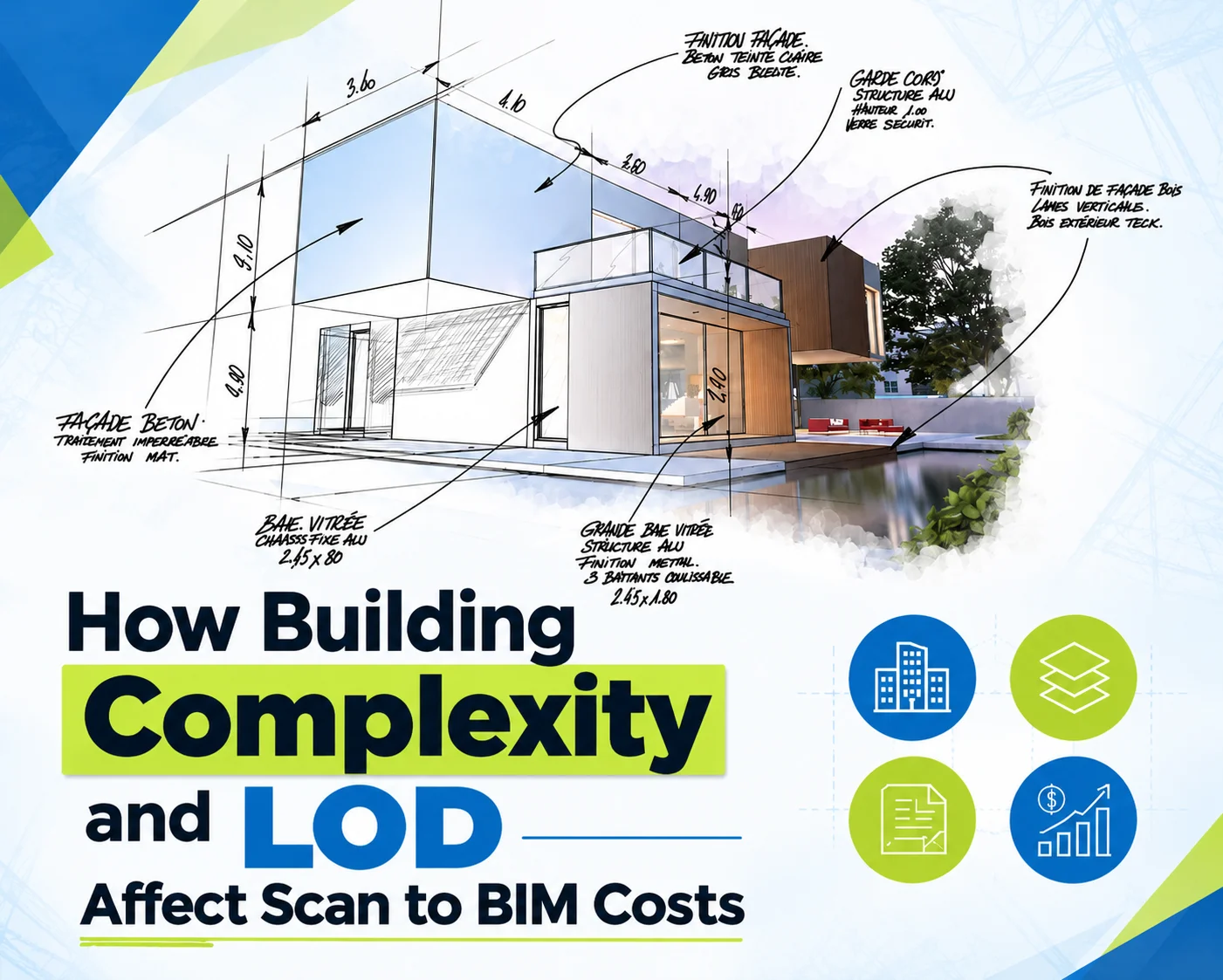
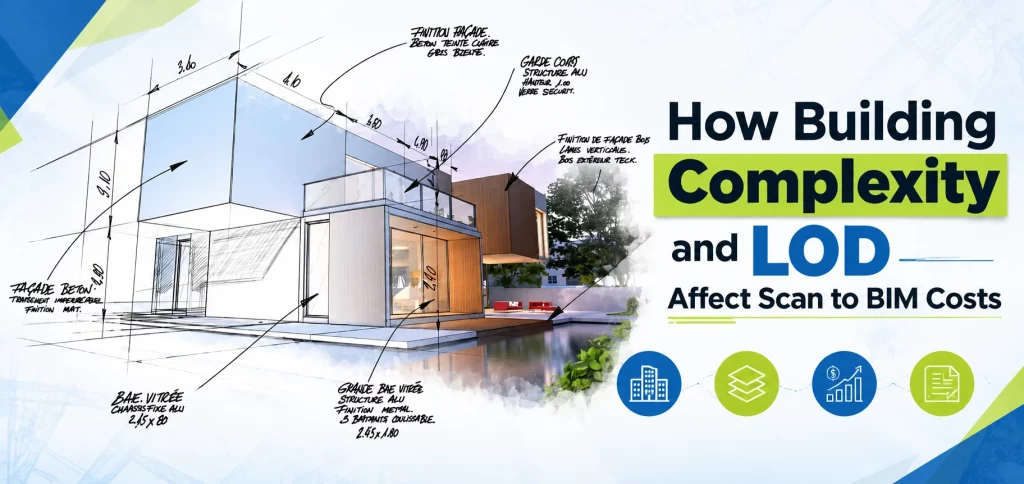
Scan to BIM Costs rarely follow floor area alone. They follow the effort needed to turn scan data into a reliable model, which depends on a building’s complexity and the information you need inside it. Two buildings of similar size can have very different budgets, such as a repetitive office floor versus a site with curved walls and congested services. Clarify these details before you request a quote for laser scan to BIM Services.
Building Information Modeling gives existing buildings a digital form that teams can measure and coordinate. On a scan-based project, a laser scanner captures conditions as a point cloud, which modelers convert into walls, structure, and services. Geometry describes where an element sits and how large it is; the information attached to it, such as material or system type, is a separate requirement. Scope and intended use decide both, so they shape Scan to BIM Costs.
Seven Key Factors That Influence Scan to BIM Costs
Several project-specific variables influence pricing, and no single one tells the whole story. Together, they shape Scan to BIM Costs far more than square footage alone does, so it helps to understand each of the seven below:
- Building Size and Geometry: Floor area, irregular layouts, curved surfaces, and ornate architectural features increase modeling effort.
- Structural Complexity: Varied beams, columns, complex roof structures, and detailed connections take longer than repetitive framing.
- MEP Systems and Services: Ductwork, piping, and electrical runs, especially concealed or congested ones, expand modeling scope.
- Point Cloud Quality: Incomplete, noisy, or misaligned scans require extra processing and interpretation.
- Level of Development (LOD): The requested level sets how much detail and information each element must carry.
- Accuracy and Tolerance Requirements: Tighter dimensional expectations call for more verification against the scan data.
- Deliverables and Project Timeline: File formats, drawings, documentation, revisions, and accelerated deadlines all influence effort.
Each variable changes the hours needed for interpretation, modeling, and checking, so the final price reflects overall modeling effort rather than any single item.
How Building Complexity Affects Scan to BIM Costs
Scan to BIM Costs climb when a building stops being repetitive. A standard office floor with uniform partitions lets modelers reuse logic across levels, while a hospital, an industrial plant, or an older renovation offers little repetition. Irregular geometry, multiple levels, and dense MEP systems each need individual interpretation. That is why a compact plant room can demand more effort than a large, open warehouse: size alone is not a reliable indicator. The best way to judge effort is to review drawings, site conditions, and goals with BIM Consulting Services.
Also Read: Converting Point Cloud Data to BIM: A Step-by-Step Guide
How Point Cloud Quality Influences Point Cloud to BIM Cost
Point cloud to BIM Cost depends heavily on how complete and reliable the scan data is. Coverage gaps, occlusions behind ceilings and equipment, weak registration accuracy, or missing areas force modelers to pause, clarify, or interpret manually. Sometimes supplementary scanning or extra review is safer than guessing. More points do not automatically mean a better or more expensive model; a clean, well-registered scan often serves a project better than a dense but misaligned one. Reliable data also makes it easier to understand Scan to BIM Costs.
Understanding Level of Development (LOD) in Building Information Modeling
Level of Development (LOD) describes how far a model element has been developed in geometry and information reliability, not simply how detailed it looks. The right level depends on the model’s intended use, such as early planning, coordination, or documentation. Elements developed further typically need more modeling, verification, and data, which makes LOD a major driver of Scan to BIM Costs. Agree on the LOD before work begins. The table below compares three common levels.
| LOD | General Modeling Characteristics | Typical Project Consideration | Potential Cost Implication |
|---|---|---|---|
| LOD 200 | Approximate geometry, size, shape, and general location | Early planning or preliminary design | Often requires less element-specific development |
| LOD 300 | More developed geometry with accurate size, shape, and location appropriate to the project | Design coordination and documentation | May require more detailed modeling and verification |
| LOD 350 | LOD 300-level development plus relevant interfaces and relationships with adjacent or connected building elements | Detailed coordination and interface planning | May require additional interface modeling and coordination |
These descriptions are general, not universal specifications. Actual requirements depend on the project’s BIM execution plan, contractual definitions, element-specific needs, and intended use. Not every element needs the same LOD, either: a project might develop structural members further than a minor fixture, and the agreed scope should say so element by element. Clear definitions keep expectations aligned between client and modeling team.
How to Manage Scan to BIM Costs Without Compromising Quality
Scan to BIM Costs are easier to manage when key decisions are made before modeling starts. Define the scope clearly, choose a suitable LOD for the model’s intended use, and share available drawings and scan data early. Confirm deliverables and agree on accuracy requirements up front. Early coordination can reduce avoidable rework and misunderstandings, although it cannot promise a specific saving. When reviewing any proposal, check each assumption carefully, starting with the Level of Development (LOD).
Conclusion
Building complexity, point cloud quality, accuracy requirements, and LOD each shape the effort a Scan to BIM project demands, which is why similar buildings can be priced differently. Defining scope and deliverables before requesting a quote leads to a more dependable estimate. If you are planning an as-built or renovation project, explore our laser scan to BIM service and request a project-specific consultation or quotation.