
Introduction
Notre-Dame Cathedral stands among the best examples of Gothic architecture in medieval Paris. The landmark has been standing tall in Paris for ages as a mark of heritage of culture, religion, and architecture. Featuring amazing stonework, arches, and world-renowned design, it continues to attract millions of visitors from across the world.
The fire raged in the building on April 15, 2019. The fire began in the attic below the famous wooden roof of the cathedral. Not much was known about what the future held for this 850-year-old monument as several parts of the cathedral had been heavily damaged due to the fire.
Why Existing Conditions Matter in Restoration Projects
In case you are reconstructing an old building, it is not possible for you to make assumptions about their dimensions or use the blueprints of the structure that are hundreds of years old. This is where an as-built survey and its resulting drawings become invaluable. The process of laser scanning provides you with precise information about the present condition of the structure.
With regards to Notre-Dame, the documentation of the current state of the building was crucial because of the extensive level of damage that had occurred due to the fire. It was important for structural engineers to know what had survived, the extent of damage, and how to stabilize the structure. Engineers would not have been able to rely on assumptions without proper drawings of the cathedral’s current condition. The first assessment served as the basis of all subsequent decisions made.
How Modern Tools Helped Rebuild a Historic Masterpiece
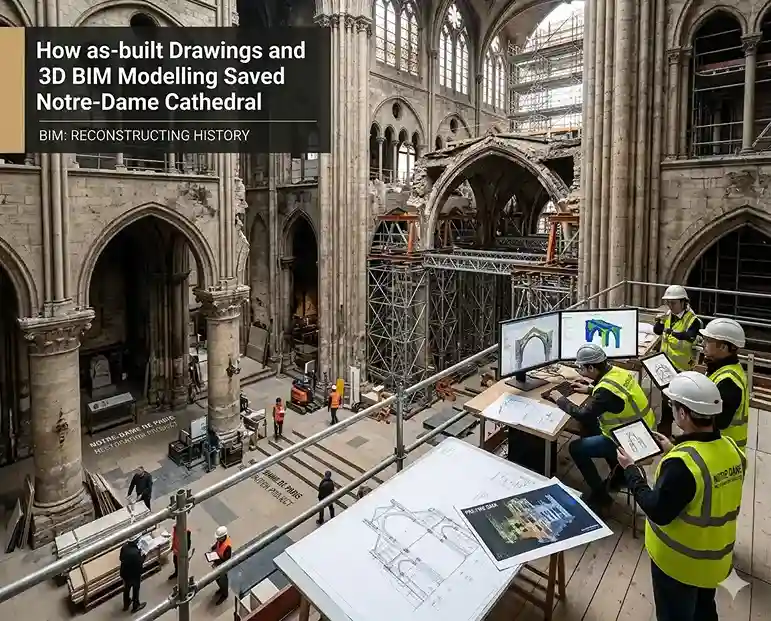
Notre Dame’s reconstruction required the creation of an accurate digital model of the building, both the existing and the one before the fire. It was here that laser scanning to BIM really came into play. The laser scanning process resulted in collecting millions of points across the whole structure to create a point cloud. The collected reality data then became part of the Building Information Model, enabling the creation of a detailed digital twin of Notre-Dame.
As well as relying on two-dimensional plans, the team was able to visualize the structure in three dimensions, see spatial relations, and find any problems with the building that may not have been clear with conventional plans. Modeling entailed coordinating between many professions, such as structural engineers, stonemasons, carpenters, and other artisans, all within one shared platform.
The coordination helped to avoid any conflicts that might have occurred due to overlapping scopes of trade. Furthermore, the finished design became a valuable document providing an accurate description of the state of affairs at the time, thus establishing a standard for further verification during the restoration process.
Major Restoration Challenges
Structural Stabilisation and Damage Assessment
The primary task of saving the building was the first one. It took engineers almost two years to make the structure stable enough for the process of reconstruction to begin. The fire led to the destruction of wood elements that sustained the roof, damage to the stone structure, and weakening of an intricate system of load-bearing walls and supports, which had been able to sustain Notre-Dame throughout the ages. Everything had to be thoroughly examined.
Removing 200 Tons of Melted Scaffolding
As the fire broke out, Notre Dame was undergoing renovation, and there were temporary metal scaffolds erected around the spire. High temperatures led to the melting of the scaffolds, resulting in a heap of molten metal that was embedded in the structure of the cathedral. The engineers were up for a challenge because they were required to remove about 200 tons of metal from the structure. This was made possible by conducting an accurate as-built survey using the laser scanner which identified the location of each scaffolding piece, its relationship to other buildings, and the order in which the dismantling process should be done. Without the exact positioning, there could have been further damage to priceless medieval stones.
Supporting All 28 Flying Buttresses
Flying buttresses of the Notre-Dame Cathedral aren’t just aesthetically pleasing objects; they are structural parts that provide support to the outward thrusting force of the high ceiling. The 28 flying buttresses all needed support while being restored. The engineers took advantage of the 3D BIM modelling to identify the forces acting on each individual buttress and then establish the ones that had been affected by the fire so as to design temporary support structures to sustain the structure. Through this virtual modelling, the engineers were able to virtually try out various support systems before applying them practically.
Rebuilding the Iconic Spire
However, the spire of the cathedral, the magnificent wooden framework constructed on the roof, was lost to flames during the disaster. It demanded both expertise and fine materials to reconstruct the spire. Selection panels picked about 1,000 oak trees from different regions of France to provide timber for the spire reconstruction project. However, the oaks had to fulfil certain requirements.
The BIM model documented the original spire’s dimensions and construction details from pre-fire drawings and photographs, providing craftspeople with the precise specifications needed to rebuild the structure authentically. The project combined traditional techniques—carpenters’ hand-fitted joinery, unchanged for centuries—with modern coordination enabled by the digital model.
What BIM Professionals Can Learn from Notre-Dame
The Notre-Dame restoration offers several critical lessons for anyone involved in heritage restoration, renovation, or adaptive reuse projects.
First, an accurate as-built survey and its resulting drawings are not optional—they’re foundational. Before you can restore anything, you must understand its current state completely.
Secondly, Laser scanning to BIM Technology provides accuracy levels that cannot be attained by using conventional approaches alone. It assists in the reduction of guesswork and minimization of mistakes through the conversion of millions of points into one coherent 3D digital model.
Thirdly, BIM Services & 3D Modelling services enhance coordination between conventional craftsmanship and current construction practices. Craftsmen, masons, and carpenters can effectively perform their tasks if provided with a visual guidance on how to do things.
Fourth, a well-developed BIM model becomes a permanent record of existing conditions. This documentation has value beyond the immediate project—it supports future maintenance, guides additional restoration work, and preserves knowledge for future generations.
Finally, heritage restoration isn’t about choosing between modern technology and traditional craftsmanship. The Notre-Dame project demonstrates that the best outcomes come from integrating both. Digital documentation and analysis support the work of master craftspeople who bring buildings like Notre-Dame back to life.
Conclusion
The restoration of Notre-Dame Cathedral represents far more than a single project – it demonstrates the vital role that digital construction technologies play in preserving our built heritage. As-built drawings, laser scan to BIM services, 3D BIM modelling, and comprehensive digital documentation enabled engineers and craftspeople to understand the cathedral’s damage, coordinate complex restoration work, and guide the reconstruction of one of the world’s most significant structures.
The project cost approached $1 billion and required nearly two years of stabilization work before major reconstruction could begin – a timeline that reflects the complexity of restoring a medieval masterpiece.
For any organization facing restoration, renovation, or heritage preservation challenges, the Notre-Dame experience illustrates an essential truth: accurate documentation of existing conditions through professional as-built surveys, reality capture, and BIM modeling is the foundation upon which successful projects are built.
Disclaimer
This article is based on publicly available information and sources. Facts and figures referenced in this article are sourced from The B1M’s documentary “The $1BN Race to Save Notre-Dame From Collapse”, official Notre-Dame restoration project announcements, and other publicly available sources. BIM Services was not involved in the Notre-Dame Cathedral restoration project. This article is intended for educational and informational purposes only and should not be construed as professional advice. For specific questions regarding heritage restoration, BIM modeling, or as-built survey services for your project, please consult with qualified professionals in your area.
References
- The B1M – The $1BN Race to Save Notre-Dame From Collapse
- Economic Times – France’s Notre-Dame Cathedral Rises from Ashes
- CNN Style – Notre-Dame Cathedral Restoration
- Ricardo Vargas – Notre-Dame: 5 PM Lessons from History’s Most Watched Restoration